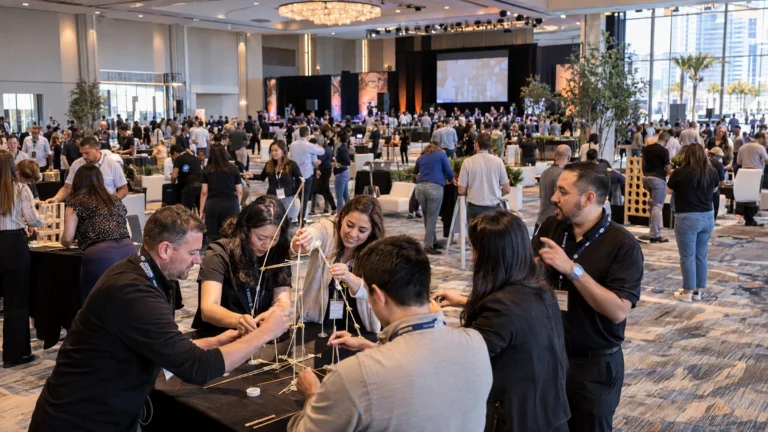
- Behind the World’s Most Memorable Brand Activations at Live Events

The best brand activations at events are not defined by scale, spectacle, or creative ambition alone. They are defined by whether the experience continues to perform once the crowd arrives, technology strains, and attention becomes fragmented.
Behind the world’s most memorable brand activations at live events is a shared operational reality. Every successful activation is built to manage volume, protect flow, and deliver a clear guest win under pressure. When those systems fail, even the most visually striking brand activation can collapse into long lines, missed data, and lost engagement.
This is why leading brands and agencies approach brand activation as an operational discipline, not just a creative exercise. In live event marketing, the difference between a viral moment and an empty booth often comes down to throughput design, role ownership, and recovery planning rather than budget or booth size.
This article answers a critical question for modern event teams: what actually makes the best brand activations at events work when conditions are unpredictable? Drawing from real-world experiential marketing examples across festivals, sports events, conferences, and pop-ups, it breaks down the systems behind interactive brand activations that scale, capture data accurately, and stay credible in front of leadership.
You will learn how top-performing teams design activations that:
- Maintain engagement during peak crowd surges
- Protect conversion and data integrity
- Adapt in real time when technology or staffing breaks
- Deliver measurable outcomes instead of surface-level impressions
These are the mechanics that turn creative ideas into durable, high-performing brand experiences, even in the most demanding live environments.
Executive Summary
The best brand activations at events succeed because they are designed to perform under pressure, not just to look impressive. High-performing brand activations prioritize operational stability to protect engagement and data when conditions become unpredictable.
- Why throughput is the hidden KPI behind scalable interactive brand activations
- How staffing structure impacts flow, data integrity, and guest experience
- What separates strong experiential marketing examples from fragile builds
- How live event marketing teams maintain performance during crowd surges and tech failures
At Stagecoach, it’s not just the music that makes headlines—it’s the moments your brand creates. With the right team, your booth becomes the spotlight. Be seen, be remembered, and own the stage.
— Daniel Meursing, CEO of Premier Staff
Memorable activations stay stable under pressure by designing for throughput, role ownership, and clean measurement, not just visuals.
Best brand activations at events don’t win because they’re the biggest build or the loudest booth. They win because they stay controlled when conditions get messy. And conditions always get messy.
Here’s the fear most teams don’t say out loud: What if this looks great, but collapses once the crowd hits? Lines double. Wi-Fi stutters. A station goes down. Suddenly, leadership isn’t asking about brand lift; they’re asking why conversion stalled.
A simple example teams often overlook: if your demo takes 90 seconds and you’ve got one station, you can serve about 40 people an hour. That’s before resets. Before questions. Before someone freezes mid-script. When volume spikes past that limit, bottlenecks form fast. Staff improvises. Data capture gets skipped. You leave with vibes instead of proof.
The Cost of Friction
Physical queues don’t just look bad; they leak outcomes. One 2025 abandonment study shows rates hitting 28% once wait times exceed ten minutes. That’s not a creative problem. It’s a flow problem. To solve this, savvy planners invest in queue management science to keep lines moving.
Staffing pressure makes this worse. A 2025 industry report found that 63% of employers identify skill gaps as a major barrier, with staffing shortages directly impacting event stability. Pair that with rising labor costs, and wages increased roughly 3.5 percent annually, per the U.S. Bureau of Labor Statistics, and inefficiency stops being cosmetic. It becomes expensive.
So, the real question becomes: what do the winners consistently get right when everything’s happening at once?
By the end of this, you’ll have patterns you can copy and warning signs you’ll know to shut down early, so your activation stays stable instead of fragile.

What separates top activations from a standard booth?
The difference between a standard booth and the best brand activations at events is rarely creative ambition. It is an operational discipline.
High-performing brand activations are designed for volume, not perfection. They anticipate hesitation points, crowd surges, and fatigue, then build systems that protect flow when those moments arrive. Standard booths, by contrast, are often built around a single ideal interaction that breaks down once conditions change.
In live event marketing, activations that scale share several defining traits:
- Clear entry and exit paths that prevent hesitation and crowding
- Short interaction cycles that maintain momentum during peak periods
- Defined staff roles that separate engagement, reset, and data capture
- Recovery plans that preserve the experience when technology or staffing fails
Most activations fail the same way. Teams add features to increase engagement without recalculating throughput. A few extra seconds per guest, an early opt-in request, or an unplanned demo variation is enough to create queues. Once queues form, staff rush, scripts degrade, and data quality erodes.
By contrast, successful interactive brand activations are often simple on paper. One action. One win. One clean exit. That simplicity is not a creative compromise. It is a strategic choice that allows experiential marketing examples to perform consistently across long days, crowded floors, and unpredictable environments.
What are the five building blocks of a memorable activation?
The best brand activations at events are built as systems. Miss one layer, and performance degrades quickly once volume increases.
These five building blocks appear consistently across scalable experiential marketing examples, regardless of format or venue.
1. A Single, Obvious First Touch
From a distance, guests should instantly understand where to go and what to do. Confusion at the entry creates hesitation, and hesitation turns into queues. Strong interactive brand activations remove choice at the start.
2. Throughput Design as a Core KPI
Throughput is the hidden metric behind every successful brand activation. Teams must define realistic interactions per station per hour, accounting for script length, resets, and guest questions. When this step is skipped, staff is forced to rush under pressure.
3. A Brand Story That Survives Noise
In loud, crowded environments, complex messaging disappears. The most effective live event marketing scripts focus on one idea per moment, delivered in language that works even when attention is fragmented.
4. Data Capture That Protects Flow
Opt-ins should happen after the guest win, not before it. Early capture introduces friction, increases abandonment, and leads to inaccurate data. Clean capture design is what separates strong experiential marketing examples from surface-level impressions.
5. Service Recovery by Design
Technology will fail. Staff must know exactly how to respond without asking for approval. Recovery plans keep the experience consistent and protect brand trust when systems break.
Together, these building blocks form an operational filter. If an activation cannot survive them, it is unlikely to perform on the floor.
Subscribe To Our NewsLetter
We help you to elevate your events with our highly skilled professionals. You got these three simple steps to book our service
What are examples of memorable activations and why did they work?
The best examples pair a fast guest win with flow control, tech ownership, and staffing plans that protect KPIs when crowds surge.
Once you understand the mechanics, the patterns become obvious on site. These experiential marketing examples reflect structures used across sports, festivals, and pop-ups, not surface creativity.
Example 1: Sports concourse activation
- Guest action (15 sec): fast challenge → win → photo
- Operational protection: entry funnel control before the build
- Likely KPI: completion + opt-ins
- Break point: concourse congestion
In brand activation sports events, crowd rhythm is everything. Miss it, and security shuts you down before marketing ever sees the data.
Example 2: Music festival activation
- Guest action: shade, water, short interaction
- Operational protection: heat planning + rotations
- Break point: staff energy drop-off
- Solution: Use experiential marketing staff trained for endurance.
Example 3: Tech conference activation
- Guest action: appointment or capped walk-up demo
- Operational protection: uptime ownership + quiet zones
- Break point: credibility after one frozen demo
Example 4: Pop-up retail activation
- Guest action: browse → guided choice
- Operational protection: inventory-style throughput thinking
- Break point: missed resets, degrading the space
Example 5: Hybrid layer add-on
- Guest action: seamless moment capture
- Operational protection: remote moderation + spike staffing
- Break point: lag
Reader takeaway: Steal the structure, not the surface.

Why are sports venues the hardest place to run activations?
Sports venues are the ultimate stress test for brand activations. If a concept works here, it will work almost anywhere.
In brand activation sports events, timing is not controlled by the brand. Calm stretches are followed by sudden surge windows driven by game action, halftime, or intermissions. Activations must absorb volume spikes without warning while staying compliant with strict venue rules.
Several constraints make live event marketing in sports environments uniquely difficult:
- Limited concourse space that restricts queue containment
- Credentialing and union boundaries that limit staffing flexibility
- Power, rigging, and placement restrictions are enforced by the venue
- Security priorities that override marketing objectives instantly
These conditions expose weak systems fast. If an activation cannot manage throughput and recovery during surge moments, it will stall or be shut down.
Modern tools can help. AI-assisted scheduling can suggest staffing swaps or break timing, but people still own escalation, compliance, and flow decisions. Technology moves information faster. Experienced teams decide what to protect when pressure hits.
This is why the best brand activations at events are often designed with sports venues in mind. When you plan for the hardest environment, performance becomes easier everywhere else.
How do you plan a brand activation step by step?
Define a 60-second win, map flow, assign roles, rehearse failure, and staff for peaks.
This is the “do it Monday” section.
Step 1: Define the guest win
If it can’t land emotionally in under 60 seconds, it won’t scale.
Step 2: Map the flow like venue ops
Entry, queue containment, exit path. Ask the real question: what happens when volume doubles? Most teams underestimate volume by assuming average flow instead of surge flow.
Step 3: Build roles, not headcount
Flow roles (greeter, guide), stability roles (reset, tech owner), control roles (data lead, floor captain). Someone must own Audibles.
Step 4: Rehearse failure
Kill Wi-Fi. Delay resets. Watch behavior. That’s the real plan.
Step 5: Staff for peaks and breaks
Rotation timing matters. This is where smart event engagement ideas live, the ones you can add without breaking flow. You might even budget for runners to keep supplies moving during these surges.
What KPIs should you track, and how do you staff for them?
Measurement only matters if it reflects reality on the floor. In live event marketing, data that ignores operational conditions is misleading.
The best brand activations at events track KPIs that connect guest behavior to staffing structure and flow. Foot traffic alone measures exposure, not engagement. The fastest way to corrupt data is to interrupt the guest win with early capture or understaffed stations.
Common failure points include one staff member managing both crowd flow and data entry, or capture tools slowing interactions during peak volume. These issues often go unnoticed until post-event reconciliation.
Defensible KPIs for brand activation programs include:
- Completion rate per station
- Dwell time bands instead of raw averages
- Opt-ins by entry lane or interaction type
- Estimated queue abandonment
- Content capture volume and post rate
- Sentiment sampling from completed interactions
- Assisted impressions tied to staff engagement
Accurate measurement requires staffing for oversight, not just participation. Supervisors must monitor flow, validate capture quality, and log real-time adjustments.
When KPIs are operationally supported, interactive brand activations deliver insights that leadership can trust instead of surface-level metrics.

What patterns show up in the best brand activations at events?
Across formats and industries, the best brand activations at events follow the same operational patterns. When these patterns are missing, experiences rarely fail loudly. They erode quietly through lost engagement, inconsistent data, and declining staff performance.
High-performing brand activations consistently show:
- One clear guest action instead of multiple competing interactions
- Short interaction cycles that remain consistent deep into long event days
- Visual clarity that reduces the need for staff policing
- Redundancy for technology, staffing, and supplies
- Scripts designed for noise, speed, and pressure
- Data capture is positioned after value delivery
- Supervisors actively watching the flow and guest behavior
- Fallback experiences that still feel intentional
These patterns explain why scalable interactive brand activations often appear simple. The simplicity allows teams to reset quickly, absorb volume surges, and maintain credibility when conditions change.
In live event marketing, durability is not accidental. It is designed into every decision long before doors open.
How do you avoid overbuilding while keeping activations memorable?
Choose trade-offs early, budget for supervision, and build backups.
Every activation is a trade-off. The cost teams miss isn’t building; it’s training and supervision. Experienced teams budget for stability first.
Backups aren’t optional. Not for tech. Not for staffing. Not in 2026.
If you’re planning a multi-day activation and want staffing that holds up under spikes, you can verify event staffing costs while you’re mapping roles.
Before the next one, audit the last: where did lines form, where did data drop, and who owned recovery?
FAQs
What roles are essential for brand activations?
For most activations, you need a mix of roles to ensure smooth operations. Key positions include Brand Ambassadors for engagement, Product Demonstrators for education, and a Team Lead for supervision. For data-heavy events, dedicated staff for check-in are crucial. To ensure you have the right mix, we recommend you hire brand ambassadors.
How do I maintain staff energy during long events?
Staff fatigue kills engagement. The best approach is to implement strict rotation schedules, ensuring staff get breaks every 2-3 hours. Provide a comfortable break area and hydrate frequently. High-energy activations require staff who are specifically trained for endurance. For multi-day festivals, it is best to hire street teams.
Why is data capture often inaccurate at events?
Inaccuracy usually stems from rushing. When staff are overwhelmed by crowds, they skip data entry fields or fake emails to move the line faster. The solution is to separate the roles: have one person manage the crowd and another solely focused on accurate data entry. You should always hire check-in staff.
How can I prevent long lines at my activation?
Long lines cause abandonment. Design your activation for high throughput by keeping interactions under 60 seconds. Use “runners” to prep guests before they reach the main station. If technology slows down, have a manual backup plan ready instantly. To manage high volumes effectively, you need to hire crowd control.
Do I need a floor manager for a small activation?
Yes, absolutely. Even small activations need a decision-maker on the floor who isn’t tied to a station. If a tablet freezes or a VIP arrives, the manager handles it while the rest of the team keeps engaging guests. This role is vital for stability. We suggest you hire production teams.
What happens if my activation tech fails?
Tech failure is inevitable. The best teams have a “low-fi” backup plan rehearsed and ready, such as paper sign-ups or physical gamification. Staff should know exactly when to switch to manual mode without asking for permission, keeping the guest experience seamless. For complex setups, hire experiential staff.
Validating Operational Readiness
The best brand activations at events are not accidents. They are engineered to perform during the hardest moments, not the easiest ones.
When activations are designed for throughput, role ownership, and recovery, they continue to deliver engagement and clean data even when crowds surge, technology falters, or conditions shift without warning. This is what separates durable brand activations from fragile builds that look strong in renderings but fail on the floor.
If you are planning a high-visibility activation and want staffing that protects flow, data integrity, and brand credibility under pressure, secure your team early.
Get an instant quote and validate your operational readiness before show day.
Are You Ready to Elevate Your Event?
Don’t wait—book Premier Staff now to secure top-tier professionals for your next event.
Recommended Posts
An event brand ambassador is the person who represents your brand to guests from setup to wrap-up. Before your event,...