
- Best Practices for Staff Training in Large-Scale Catering

Executive summary
Training catering staff for large events isn’t about covering tasks it’s about preparing your team for how service actually unfolds under pressure, which comes down to knowing where service will slow down, training staff around real service moments, assigning clear roles and accountability, practicing transitions in advance, and aligning the team right before service begins so that service stays consistent even during peak demand, with shorter wait times, smoother flow, and coordination that feels intentional rather than reactive.
Introduction
If you’re planning a large event, knowing the best practices for staff training in large-scale catering can make or break your guest experience.
In high-pressure environments, even small delays can turn into visible service issues. That’s why training isn’t just about roles. It’s about preparing your team for real service conditions.
In this guide, you’ll learn a practical 5-step framework to train catering staff for peak moments, smooth transitions, and consistent execution so your event feels seamless from start to finish.
The biggest giveaway that a catering team isn't properly trained is how they handle their first tray out of the kitchen. If that first tray goes out half-full, uneven, or delayed, it means no one aligned on pacing and that small mistake compounds into slow service for the next hour.
— Daniel Meursing, CEO of Premier Staff
Training catering staff for large events means preparing them for real service pressure, not just basic tasks.
The most effective approach focuses on:
- Training around service moments, not job titles
- Practicing peak demand scenarios
- Assigning clear zones and responsibilities
- Rehearsing transitions before the event
This ensures your team knows exactly what to do when the room gets busy.
The challenge
Large events with 200+ guests are already complex. The last thing you want is catering staff who aren’t fully prepared. When staff don’t know what they’re doing, chaos follows, confused service, frustrated guests, and you’re stressed the entire night.
Most service breakdowns happen in the same places:
- The first 15 minutes of guest arrival
- The first bar surge
- The transition into dinner
These are the moments where untrained teams fall behind and where guests start noticing delays.
Training catering staff sounds straightforward until you’re in the middle of a live event and things start slipping. Orders get delayed, communication breaks down between kitchen and floor, and suddenly guests are waiting while your team scrambles to catch up.

Why Catering Staff Training Matters More Than You Think
According to industry estimates, over 70% of service delays at large events happen during peak transitions like cocktail hour and dinner service.
In our experience working with large-scale events, the difference between a smooth event and a chaotic one often comes down to how well staff are trained for these exact moments.
For example, at a 400-guest corporate event, a trained team reduced bar wait times by nearly 30% simply by adjusting service flow and pre-assigning restocking roles.
That’s the impact of structured training.
Subscribe To Our NewsLetter
We help you to elevate your events with our highly skilled professionals. You got these three simple steps to book our service
A simple five-step way to train catering staff for large-scale events
1) Most teams start by assigning roles but that’s not where service actually breaks down.
Most teams miss this step and instead train around roles (“you’re a server,” “you’re on bar”).
The problem is that roles don’t fail moments do. If you only train roles, staff understand their position but not when things start to speed up or fall behind.
The main issue: most teams get a role assignment but not a picture of where service will get messy.
Before anyone touches a tray or bar station, walk the team through the three moments that usually break first: cocktail hour rush, the move into dinner, and the first 20 minutes of peak bar service. That’s your training starting point.
Do this:
- Mark the likely traffic jams on a printed floor plan
- Tell each person what they own in that exact moment
- Run a five-minute “first rush” practice before guest arrival
This is what prevents early-service delays the point where most guests form their first impression of your event.
Guest entry → Cocktail bar crowd → Passed apps crossing traffic → Dinner call
At a 300-guest corporate gala in Chicago, this might mean assigning one server only to water refill near the ballroom entrance.
At a California vineyard wedding, it might mean training one lead to pull servers from cocktail hour into dinner setup without waiting to be told.
2) Train by service moment, not by generic “good service” rules
Here’s where a lot of training goes flat: people explain standards, but nobody teaches what the staff should physically do when timing changes.
The goal here is to remove hesitation. Staff shouldn’t be thinking, “What do I do now?” they should already know the next move based on the moment.
So break training into live service moments.
Service Moment | What Staff Should Practice | What Manager Should Say |
Cocktail hour opens | Tray path, refill path, guest approach | “Don’t bunch at the kitchen door. Stagger your exit.” |
Dinner transition | Clearing, reset, silent repositioning | “Once speeches start, two clear, two hold, one resets water.” |
Peak bar rush | Fast orders, short language, restock rhythm | “Simple pours first. Restock before you’re empty, not after.” |
This kind of training reduces bottlenecks during peak service especially at the bar, where even a 2–3 minute delay per guest quickly turns into long lines.
That’s more useful than telling people to “stay organized.”
At a Las Vegas trade show mixer, staff need to practice serving guests who come in waves between sessions.
At a fundraiser gala, they need to know how to pause movement during a speech without freezing service completely.
Cocktail hour → Pause for program → Reset → Dinner service
3) Give every person one zone, one backup job, and one handoff
The main issue here is overlap. If everyone thinks “someone else has it,” nobody has it.
A simple training fix: every staffer gets three things before service starts.
- Zone: where they stay anchored
- Backup job: what they pick up when traffic spikes
- Handoff: who they report to when something slips
When this isn’t defined, small gaps turn into visible problems empty water glasses, uncleared tables, or slow bar restocking.
Example:
Role | Zone | Backup Job | Handoff |
Server A | East cocktail floor | Water station reset | Captain |
Bartender 1 | Main bar left well | Ice callout | Bar lead |
Busser 2 | Ballroom rear | Glass sweep | Floor manager |
This structure keeps coverage consistent across the room, even when one area suddenly gets busy.
This works especially well at brand activations in LA, where guest flow is uneven, and at festival-style VIP lounges, where one surge can wipe out glassware or garnish stock fast.
My zone → My backup job → My person
When staff can answer those three things without hesitation, training has actually landed.
4) Rehearse transitions like scene changes
Dinner transitions are where events start looking sloppy not because the staff are bad, but because nobody practiced the switch.
Most service inconsistencies don’t happen during steady flow they happen during transitions, when staff aren’t aligned on what changes next.
Train the transition as its own drill.
Run it like this:
- Call the exact trigger: “Speech ends, dinner doors open.”
- Time the reset
- Watch who stalls, crosses traffic, or waits for permission
- Then fix the movement, not just the attitude
The goal is to remove hesitation so the transition feels immediate and coordinated from a guest perspective.
For example, at a 500-guest hotel ballroom dinner, you might train servers to clear only outer glassware first so tables don’t look half-finished.
At a wedding with a room flip, you train who stays guest-facing and who disappears to reset service stations.
Speech ends → Clear path opens → Staff reposition → First plates move
5) End with a 10-minute reset huddle, not a motivational speech
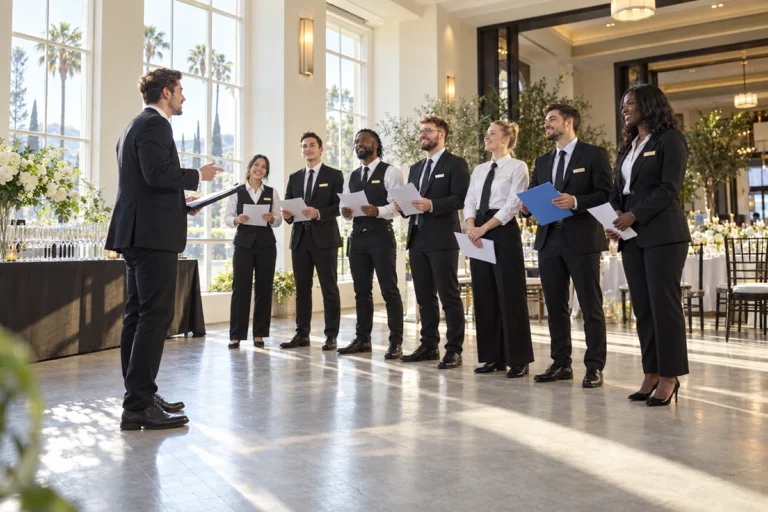
Right before doors open, don’t give a long briefing. Use the last 10 minutes to lock in execution.
Long briefings don’t improve performance clarity right before service does.
Try this format:
First 3 minutes: Call out the hardest part of the event.
Example: “Biggest pressure point is the bar line at 6:40.”
Next 4 minutes: Confirm assignments out loud. “Who owns water? Who floats? Who covers if the right bar backs up?”
Last 3 minutes: Run one quick scenario. “If cocktail hour runs long by 15 minutes, what changes?”
This ensures everyone is aligned on what matters most before the event begins especially the busiest moment.
Pressure point → Role check → Quick scenario
This works because it keeps training close to the real shift. At a corporate dinner, the huddle might focus on timing with AV cues.
At a large wedding, it might focus on tray circulation before the couple enters.
That’s the goal, really. Not a polished briefing. A team that knows exactly what to do when the room gets busy.

The moment you realise your catering team isnt ready
It’s 6:15 PM and cocktail hour started at 6. Guests are wrapped around the bar, and your bartenders are moving in slow motion. Nobody told them that right NOW is actually busy. That’s when you realize something’s off.
Then dinner service happens. Staff are serving from the left on some tables, the right on others. Half the room has water, half doesn’t. It’s not coordinated it feels like separate teams instead of one operation. Guests notice. They’re literally comparing notes at table 5.
A guest spills wine on the tablecloth. Your server freezes for a second, then dabs at it slowly and somehow makes it MORE awkward. The whole table goes quiet. Not professional just uncomfortable.
By dessert, you’re stressed. You’re doing laps around the room instead of actually enjoying your event. Guests feel rushed. Your event the thing you actually invested money and time into feels chaotic instead of polished.
The real cost? It’s not just that night. It’s what people remember. It’s whether they’d actually recommend you. It’s whether you felt like a host or a floor manager with a clipboard.
That’s the difference between a prepared team and an unprepared one.
Quick checklist: Before Your Event Starts
Before your event, this is what a properly trained team should already have covered not figured out on the spot.
- Do all staff know their roles?
- Has a briefing been done?
- Does everyone understand the timeline?
- Are supervisors clearly assigned?
- Is there backup staff available?
- Have you done a full walkthrough?
- Does every staff member feel confident?
If any box isn’t checked, address it before guests arrive.
Make Your Next Event Stress-Free
At large events, guests don’t remember the plan; they remember how the event felt.
- Whether the service was smooth or slow
- Whether staff felt confident or unsure
- Whether the experience felt polished or slightly off
That all comes down to preparation.
Training catering staff isn’t about covering basic tasks; it’s about making sure every part of the event runs in sync, even when the room gets busy.
When that happens, service feels effortless, guests stay engaged, and you’re not pulled into solving problems during your own event.
That’s the real goal: not just a well-run event, but one you can actually enjoy.

FAQs
What are the best practices for staff training in large-scale catering?
The best practices include training around service moments, assigning clear roles and zones, rehearsing transitions, and running pre-event simulations. These methods help staff stay coordinated and responsive during peak demand. If you’re planning a large event, working with experienced catering staff who already come trained and role-ready can make a significant difference in how smoothly your service runs.
What's the difference between full-service and day-of staffing?
Full-service staffing starts weeks before your event with planning, coordination, and setup. Day-of staffing focuses only on the event itself. If you want someone managing details from the beginning not just showing up the day of check out our guide to hiring event staff for more insight, or explore hospitality staff options that cover everything from pre-event coordination through the final guest farewell.
How do I prevent service issues during my event?
The best prevention is clear roles and trained staff who stay focused. Most problems happen when staff isn’t sure what they’re supposed to be doing. Our team works with strong communication strategies for event teams, so each person knows exactly what their job is and how it connects to the whole experience. Having dedicated check-in teams at key entry points is one of the simplest ways to prevent bottlenecks and confusion before they ripple through the rest of your event.
What staff roles do I need for my event?
It depends on your event size and style, but most events need greeters, service staff, and at least one person managing the flow behind the scenes. That flow manager is the most important person they catch small issues before they become big ones. We have trained hospitality professionals ready to fill every role needed for your specific event, from front-of-house greeters to behind-the-scenes coordinators.
How do I make sure service stays consistent throughout my event?
Consistency comes from clear expectations, trained staff, and someone checking in during the event. If something shifts like timing or guest flow your team needs to adapt together without losing the personal touch. Using a post-event analysis framework helps you measure what worked and build on it for next time. Teams built around crowd management and structured guest flow are especially valuable for maintaining that consistency when attendance peaks or the schedule shifts unexpectedly.
Make Your Next Event Run Exactly as Planned
You shouldn’t have to manage staff during your own event.
At Premier Staff, we don’t just provide people—we provide trained teams who understand event flow, pressure points, and guest expectations before they arrive.
That means:
- Faster service during peak moments
- Better coordination across the floor
- A smoother, more professional guest experience
If you’re planning a large event and want it to run without stress, it starts with the right team.
👉 Talk to us about your event and get staff who are already trained to execute.
Are You Ready to Elevate Your Event?
Don’t wait—book Premier Staff now to secure top-tier professionals for your next event.
Recommended Posts

An event brand ambassador is the person who represents your brand to guests from setup to wrap-up. Before your event,...