
- Event Coordinator Jobs: Your Step-by-Step Guide to Breaking In

A brand will invest millions in a corporate summit hoping for a single, powerful takeaway. Too often, that takeaway is the 30-minute chaotic check-in line. The global events industry is booming, with strong momentum across in-person experiences. This growth means brands are investing heavily in flawless, in-person experiences, and the person responsible for preventing that “check-in chaos” is the Event Coordinator.
This guide is for first-time entrants, students, career switchers, and those in production assistant jobs looking for a clear pathway. This is a structured 12-week plan to land your first of many event coordinator jobs and perform confidently on-site.
Executive Summary
This guide is a 12-week plan for aspiring event coordinators. Learn the essential skills, how to build a portfolio, and how to gain experience in production assistant jobs. We cover the step-by-step path from entry-level to landing your first major event coordinator job.
Every coordinator learns to think two steps ahead. Precision under pressure defines leadership. At Premier Staff, we give emerging professionals in event coordinator jobs the systems and training to turn opportunities into long-term careers.
— Daniel Meursing, CEO of Premier Staff
What Does an Event Coordinator Really Do?

To get a job, you first need to understand the job. An Event Coordinator acts as an operational translator; they are the critical link connecting the client’s goals, the venue’s logistics, and the staffing team’s on-the-ground execution.
While an Event Planner designs the “what” and “why,” the Coordinator owns the “how” and “when.” Common duties include:
- Managing vendor schedules (AV, catering, security).
- Reviewing and executing “run-of-show” documents.
- Overseeing conference staffing flow.
- Troubleshooting last-minute changes (e.g., a speaker is late, a mic fails).
We detail the Planner vs. Coordinator roles in another guide, but the simplest distinction is this: the Planner builds the blueprint, and the Coordinator builds the event. This role is essential in both corporate event staffing and conference staffing, making it a versatile career path.
#Step 1: Build a Foundation of Industry Awareness (Weeks 1–2)
Your first objective is to learn the language of the industry. You need to understand the ecosystem you’re trying to enter.
- Learn the Event Types: Research the differences between corporate conferences, trade shows, product launches, and non-profit galas.
- Follow Industry Bodies: Follow major industry associations like Meeting Professionals International (MPI) and the Event Industry Council (EIC) on LinkedIn. Their articles will teach you the trends and terminology.
- Study Job Boards: Look at real job postings for event production assistant roles. Note the specific skills and software they mention.
- Read Up: Review articles on corporate event staffing trends to understand what clients are asking for right now.
Actionables:
- List 3-5 event staffing agencies in your city.
- Set up job alerts for “event coordinator jobs” and “event production assistant.”
#Step 2: Gain Entry-Level Experience (Weeks 3–4)
Your next objective is to get hands-on exposure. An event is a live-fire environment, and you can only learn so much from a book. This is the fastest way to gain experience.
- Start Small: Volunteer or work freelance for local conferences, university galas, or non-profit fundraisers. These roles are often easier to get and provide a great learning environment.
- Take Production Assistant Jobs: This is the #1 way to get exposure. Professional agencies are always hiring for production assistant jobs. You will get paid to observe real logistics in motion and learn from seasoned professionals.
- Focus on the Paperwork: While on-site, ask to see the run-of-show, the site map, and the vendor contract list. Focus on learning why things are happening, not just what is happening.
Checklist:
- Minimum 2 live events observed or worked.
- 1 reference from an on-site supervisor or agency manager.
- Basic familiarity with event software (even just seeing it in use). This is key for event coordinator jobs.
The PA-to-Coordinator Readiness Rubric
As you gain experience, managers are not just looking for hard work; they are looking for a shift in your mindset. Use this rubric to track your growth from an assistant to a coordinator-in-training. This is what we look for when promoting talent for event coordinator jobs.
Core Competency | Developing (PA Mindset) | Proficient (Senior PA) | Coordinator-Ready (Leader) |
Problem Solving | You report problems as they happen. (e.g., “The check-in line is getting long.”) | You propose solutions with the problem. (e.g., “The line is long. Can I create a second check-in station?”) | You anticipate and solve problems before they happen. (e.g., “I saw the 3pm session ends soon, so I pre-set a second check-in station for the rush.”) |
Task Management | You complete your assigned tasks perfectly. | You complete your tasks and then actively ask your lead, “What’s next?” | You complete your tasks, see what else needs to be done, and take ownership of it without being asked. |
Communication | You listen to the radio and follow instructions. | You use the radio with clear, professional language to report your status. | You act as a communication hub for your zone, relaying key information to other team members and your lead. |
Vendor Interaction | You show vendors where their assigned spot is. | You can check in a vendor against a checklist and get their signature. | You can confidently review a vendor’s run-of-show, confirm their deliverables, and troubleshoot if their setup is incorrect. |
Mentor Tip: When you consistently operate in the “Coordinator-Ready” column, you are ready to start building your portfolio for your first full-time event coordinator job.
#Step 3: Create a Starter Portfolio (Weeks 5–6)
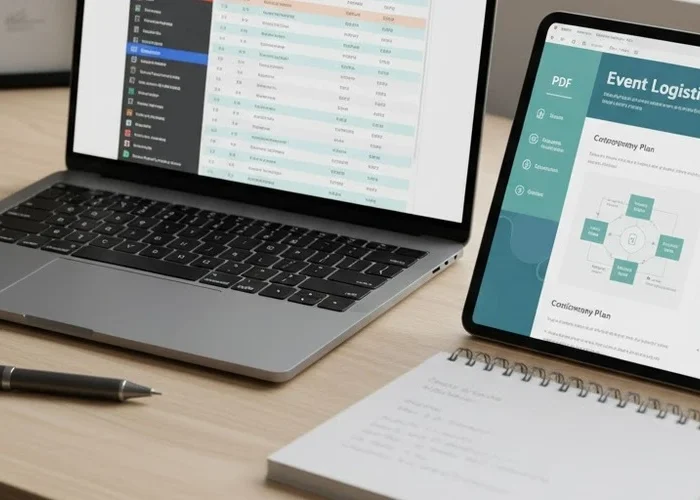
Your next objective is to convert your entry-level experience into tangible credibility. An aspiring chef has to show photos of their food; an aspiring coordinator has to show proof of their organizational skills. This is what will make you stand out when applying for your first event coordinator jobs.
Even if you haven’t “led” an event, you can show evidence of your reliability and, most importantly, your understanding of how an event functions. Your portfolio demonstrates that you don’t just follow a checklist; you understand why the checklist exists.
Here’s what to include in your starter portfolio:
- A Sample Run-of-Show: Find a template online and create a detailed run-of-show for a fictional event. Be meticulous. Include vendor arrival times, staff briefing schedules, door-opening times, and key transitions.
- Event Flow Diagrams: Create a simple visual map of a key process. This could be an ingress plan (how guests get from the door, through security, to check-in) or a room flip. This shows you think like an operations manager.
- A “What Could Go Wrong” Plan: Create a one-page contingency plan. List 3-5 potential problems (e.g., “Registration system fails,” “Keynote speaker is late,” “Bad weather for an outdoor event”) and write 2-3 bullet points of your proposed solution for each.
- A Reflection: Write a one-page reflection on lessons learned from your production assistant jobs. What did you observe? What would you do differently? This demonstrates critical thinking.
Pro-Tip: How to Present Your Portfolio
Don’t build a flashy, complicated website. Do create a single, clean, professional PDF. Hiring managers for event coordinator jobs are busy. They want to see that you can organize information clearly and logically. A simple, well-designed PDF that they can easily download and attach to your file is far more effective than a website link they have to click through.
#Step 4: Network Like an Insider (Weeks 7–8)
Now that you have the experience and the portfolio, your objective is to get visible to hiring managers and agencies. In the event industry, your reputation and your network are everything.
- Join Professional Associations: Register for your local International Live Events Association (ILEA) chapter as a student or young professional. You’ll meet exactly the people (event coordinators, agency owners) who hire for the roles you want.
- Connect on LinkedIn: Find event coordinators and production leads in your city and send a simple, professional connection request. Your goal is to build a passive network so that when you start applying, you are a familiar name, not a stranger.
- Engage with Staffing Partners: Follow the social media accounts of top corporate event staffing agencies. Engage with their content. This shows you are serious about the industry.
Follow Up: After you work an event as a production assistant, get the business card or LinkedIn profile of your on-site manager. Send them a one-sentence message: “It was a pleasure working with you on the [Event Name] event. I appreciated your insight on the conference staffing logistics and hope our paths cross again.” This simple act of professionalism puts you on their “reliable” list.
Subscribe To Our NewsLetter
We help you to elevate your events with our highly skilled professionals. You got these three simple steps to book our service
#Step 5: Apply to Targeted Event Coordinator Jobs (Weeks 9–10)
It’s time to move from exploration to active applications. Be strategic about where you apply for your first event coordinator jobs.
Where to Apply:
- Corporate Event Staffing Agencies: This is often the best place to start. Agencies like ours have the highest volume of events and are constantly looking for talent to promote from within.
- In-House Event Teams: Look for “Event Coordinator” or “Marketing Coordinator (Events)” roles at large corporations, universities, or non-profits that host their own events.
- Experiential Marketing Firms: These creative agencies hire coordinators to manage the logistics of their brand activations.
How to Apply:
- Tailor Your Resume: Your resume must scream “logistics and operations.” Use action verbs like “Coordinated,” “Managed,” “Scheduled,” and “Executed.”
- Include Measurable Outcomes: Don’t just list duties. List outcomes. Instead of “Helped with check-in,” write “Assisted in the check-in and greeting of 300+ attendees for a corporate summit.”
- Mention Your Tech Tools: List any event-related software you’ve used, even if you’re just a beginner: Trello, Asana, Slack, GSuite, Cvent, etc.
Pro Tip:
Keep an adaptable resume template. Have one version that highlights your reliability and teamwork for production assistant jobs and another that emphasizes your organizational skills and leadership potential for event coordinator jobs.
#Step 6: Prepare for Interviews and Trial Days (Weeks 11–12)
Your objective is to showcase your readiness for event coordinator jobs. Hiring managers are looking for two things: logistical competence and grace under pressure.
Your portfolio and resume get you in the door. Your interview performance seals the deal. Be prepared to discuss typical interview topics like how you manage last-minute changes, communicate with difficult vendors, and prioritize the guest experience when things go wrong.
For any trial days or “shadow” opportunities, be proactive. Bring a notebook, confirm the chain of command, and ask for briefing documents in advance. Your goal is to demonstrate that you are an organized, reliable, and calm presence in a chaotic environment.
Expert Insight: The 3 Interview Questions You Must Be Ready For
As a hiring manager, I don’t just want to know what you’ve done. I want to know how you think. Be ready for these scenario-based questions for event coordinator jobs:
1. “It’s 10 minutes before doors open. Your main registration system goes down, and there are 500 guests in the lobby. What are your first three steps?”
- Why they ask this: It tests your grace under pressure and your ability to triage a high-stress situation.
- A+ Answer: “My first step is to stay calm and project confidence to the team. Second, I immediately switch to our pre-planned manual backup, like clipboards with printed guest lists, to keep the line moving. Third, I deploy a ‘floater’ to communicate with the line, letting them know we’re on it, while my team lead gets the tech vendor on the radio.”
2. “A high-value sponsor is angry because their booth location has less foot traffic than they were promised. How do you handle this?”
- Why they ask this: It tests your problem-solving and client-facing skills.
- A+ Answer: “My first step is to listen and validate their frustration. Then, I would analyze the problem: Is the foot traffic actually low, or just perceived as low? I’d review the event flow and see if we can add a new sign, a pop-up greeter, or mention them in the next stage announcement to drive traffic to their location. It’s about offering solutions, not excuses.”
3. “You’re in the middle of a room flip, and the catering team is 20 minutes late. What do you do?”
- Why they ask this: It tests your proactivity and vendor management skills.
- A+ Answer: “I wouldn’t wait until they are 20 minutes late. At 5 minutes late, I’m already on the radio with the catering captain for an ETA. I’m also cross-checking the schedule to see what this delay impacts next; does it push back the keynote? I’d then immediately update my event manager so they can make the high-level decision on whether to adjust the schedule or hold.”

How to Leverage Event Production Assistant Experience into Coordination Roles
The primary objective is to bridge the gap between your entry-level production assistant jobs and the event coordinator jobs you want. The key is to reframe your experience. You weren’t just “helping”; you were performing a specific, valuable function.
Translate your leveraging PA experience into measurable skills on your resume. Here’s how:
What You Did (PA Language) | What You Achieved (Coordinator Language) |
“Supported vendor setup” | “Coordinated cross-departmental logistics for AV, catering, and staging” |
“Helped with registration” | “Managed attendee flow and queue efficiency for 300+ guests” |
“Handed out radios” | “Managed and tracked all on-site communication assets” |
“Watched a station” | “Ensured brand compliance and guest engagement at a sponsor activation” |
The 12-Week Action Plan Recap
Here is a simple table that recaps your 12-week journey. This visual progression shows how you can systematically move from learning and exposure to active execution.
Week Range | Focus | Key Deliverables |
Weeks 1–2 | Industry Research | Shortlist of target agencies + active job alerts. |
Weeks 3–4 | Gain Experience | Minimum of 2 live event credits + 1 supervisor reference. |
Weeks 5–6 | Build Portfolio | A professional PDF with a sample run-of-show & contingency plan. |
Weeks 7–8 | Network | 5 new, meaningful LinkedIn connections + 2 agency roster applications. |
Weeks 9–10 | Apply | 3+ tailored resumes sent for targeted event coordinator jobs. |
Weeks 11–12 | Interview | Mock interview practice + a successful shadow day or final interview. |
What You’ll Actually Do on Event Day
Your objective as a coordinator is to offer day-of realism and be the calm center of the storm.
Your day starts long before the guests arrive, often 90 minutes before the official staff call time. You’ll be one of the first on-site, walking the venue, and double-checking your plan. You will review the staff briefing, confirm radio channels, and memorize the escalation paths.
This requires advanced project management: you’ll be overseeing registration setup, confirming catering windows, and ensuring the A/V team is in sync with the stage manager. You are the point of contact, the problem-solver, and the person who ensures the planner’s vision comes to life. This is the reality of event coordinator jobs.
An Insider’s View: The “Radio Test”
“The first day I ever worked a major corporate event, my lead handed me a radio and said, ‘Your main job is to be my shadow and listen. Don’t speak on the main channel unless someone’s on fire.’ It was the best advice I ever got. I learned the entire operational language, all the codes, the key players, and the rhythm of a high-stakes event, just by listening. Your first few events are your education. Arrive early, keep your eyes open, and absorb everything. That’s how you build the confidence to truly own a role in event coordinator jobs.”
A simple event day checklist for a coordinator looks like this:
- Arrival: Venue walk-through, meet with leads, check comms.
- Pre-Opening: Supervise staff check-in, run final a/v and catering checks, finalize green room.
- Live Run: Manage ingress, monitor the run-of-show, solve issues in real-time, be the lead point of contact.
- Teardown: Supervise staff check-out, coordinate vendor load-out, and secure all rental assets.
Common Early Mistakes to Avoid
Every new event coordinator makes mistakes. The key is to avoid the common ones that signal a lack of preparation to a hiring manager. Here are the rookie errors to prevent.
- Forgetting to confirm vendor arrival times: Never assume a vendor will arrive on time based on the contract. A professional coordinator re-confirms all load-in times 24-48 hours in advance. Not doing so is a costly staffing mistake.
- Relying only on verbal instructions: The event floor is loud and chaotic. Always follow up a verbal direction with a text or radio confirmation. If it isn’t in writing, it wasn’t said.
- Ignoring the chain of command: Do not go directly to the main event planner with a small problem. Report issues to your direct lead or manager, who can then escalate if necessary.
- Neglecting personal prep: An event is a marathon. Failing to hydrate, eat a real meal beforehand, or wear professional, comfortable shoes will lead to a performance drop by the sixth hour.
Where to Grow After Your First Big Event
Landing your first of many event coordinator jobs is the starting line, not the finish line. Once you have a few successful events in your portfolio, the next step is to specialize and build your leadership skills.
- Specialize: You’ll quickly learn what you enjoy. You can choose to focus on the high-stakes, logistical precision of corporate event staffing or the complex, multi-day demands of conference staffing.
- Earn Certifications: As you gain experience, consider professional certifications to signal your commitment. The CMP (Certified Meeting Professional) or CSEP (Certified Special Events Professional) are highly respected in the industry.
- Volunteer for Leadership: Ask your manager if you can act as a “Zone Lead” or “Team Captain” at your next event. This is the best way to develop the leadership skills needed for a Senior Coordinator or Event Manager role.
- Keep a KPI Log: Maintain a personal log of your accomplishments: “Managed check-in for 1,000 attendees with an average wait time of 3 minutes,” or “Oversaw a 30-minute room flip, finishing 5 minutes ahead of schedule.”
2025 Trend Alert: The Rise of the Hybrid Event Coordinator
Expert Insight: Being an event coordinator in 2025 means you are often managing two events at once: the one in the room and the one on the screen. The most valuable coordinators today are also “virtual producers.”
- New Skill Stack: This requires a new set of technical skills, including a working knowledge of broadcast platforms (like vFairs, Zoom Events, or Hopin), understanding how to manage a digital Q&A, and coordinating with an AV team to ensure the virtual audience’s experience is just as engaging as the live one.
- Career Impact: As a beginner, even taking a short online course in “Virtual Event Production” and adding it to your portfolio can make you dramatically more hirable than a candidate who only knows in-person logistics. This signals to corporate event staffing agencies that you understand the future of the industry.
Real Tools That Make You Look Experienced
Your objective is to position yourself for efficiency. Using the right tools shows managers that you are organized and professional.
- Planning: Asana, Trello, and Airtable are excellent for managing complex task lists and vendor timelines.
- Communication: Proficiency in Slack, Google Chat, and understanding professional radio call sheets is essential.
- Guest Flow: Basic knowledge of Excel for building guest lists and familiarity with QR code scanners are must-have skills.
- Event software is a broad category, but showing you are familiar with any of these platforms gives you a significant advantage.
Key Takeaways
- Treat event coordination as a structured career, not a freelance patchwork.
- The fastest path to event coordinator jobs runs through production assistant jobs and networking.
- Build a portfolio that showcases your logistical and organizational skills, not aesthetics.
- Specializing in corporate event staffing or conference staffing can accelerate your career.
- Growth comes from predictability; event coordinator jobs are trusted to deliver precision every time.
Securing Your First Coordinator Role
The path to becoming a successful event coordinator is a rewarding journey. As this guide shows, the key is to build your reputation on reliability, gain hands-on experience in production assistant jobs, and proactively develop your operational skills. For brands, the strategy for success is equally clear: it hinges on deploying a managed system. Understanding how a professional team is built is essential, and the ability to get an instant quote is the first step in exploring a partnership that delivers true ROI.
FAQs
What qualifications do I need to apply for event coordinator jobs?
A degree in hospitality helps, but practical experience from event production assistant roles is what employers value most. We look for a record of reliability and real event hours when building our Production Teams.
How can I gain event experience if no one has hired me yet?
Volunteer at Corporate events, nonprofit galas, or city festivals. Keep documentation, photos, and references. Even small roles help demonstrate consistency and teamwork.
How do I stand out when applying for entry-level event coordinator jobs?
Showcase your organizational skills. Include evidence of logistics support or on-site troubleshooting. For Conference Staff roles, we look for composure under pressure more than creative flair.
Is being an event production assistant a good path to coordination roles?
Yes, it’s the most reliable way to learn real logistics and a common path for our Commencements & Graduations staff. Track your tasks and convert responsibilities into coordinator-ready language on your resume. This is the best way to get noticed for event coordinator jobs.
How can Premier Staff help me land event coordinator jobs?
Premier Staff provides the training, mentorship, and high-profile placements to accelerate your career. Many of our top coordinators started as Brand Ambassadors and grew with us. Check our careers page for current openings.
Are You Ready to Elevate Your Event?
Don’t wait—book Premier Staff now to secure top-tier professionals for your next event.
Recommended Posts