
- How to Find Reliable Trade Show Staffing for Your Booth

You are planning a trade show, your booth is designed, and leadership expects a real pipeline from the floor. The question becomes simple and urgent: how do you hire reliable trade show booth staffing that actually performs, not just shows up?
Reliable trade show booth staffing is not about hiring friendly faces or filling shifts. It is about putting trained people on the floor who can pull attendees in, qualify the right conversations, manage demos smoothly, and capture clean lead data hour after hour. When staffing breaks down, the damage is quiet but costly. Engagement drops, scans decline, notes disappear, and your internal team burns out trying to compensate.
This guide answers exactly how to find a reliable trade show staffing agency for your booth. You will learn where to hire booth staff, which roles matter most, how to vet trade show staffing companies, and what red flags signal risk before show day. The goal is simple: help you choose trade show staffing agencies that protect ROI, maintain lead quality, and perform under real show floor pressure.
Executive Summary
Trade show staffing companies are only reliable when they can perform consistently on the show floor, not just fill shifts. Real reliability means clear roles, trained engagement, accurate lead capture, fast replacement coverage, and active supervision during peak traffic. This guide shows how to vet trade show staffing agencies, design booth roles that protect ROI, and avoid common staffing failures that quietly kill lead quality and pipeline.
After supporting thousands of booth days, we’ve found that staffing success depends entirely on performance design, rigorous briefing, and active supervision. We treat reliability as an engineered system.
— Daniel Meursing, CEO of Premier Staff
What “Reliable” Means in Booth Staffing (and Why ROI Lives Here)

Doors open. Aisle traffic finally shows up. Your internal team is juggling meetings, demos, Slack pings, and a VP who just wandered off. Meanwhile, your booth staff has to initiate the first 50 conversations of the day, cold. That’s the moment where reliability actually matters. It’s also where most trade show staffing agencies either prove themselves… or disappear behind “we’ll do our best.”
Reliable doesn’t mean “they showed up.” It means on time, correct wardrobe, confident openers, clean lead notes, and real coverage during breaks.
The stakes aren’t shrinking either. The Freeman Exhibitor Trends Report found that 79% of exhibitors plan to attend the same number of events or more next year. That means more competition for attention and less tolerance for weak execution.
Here’s the consequence chain nobody budgets for. Low engagement turns into fewer scans. Fewer scans turn into fewer qualified conversations. Sales looks at the CRM and shrugs. Marketing gets blamed. The next show’s budget gets “revisited.” The first thing that breaks is rarely the demo; it’s the handoff. No qualification, no notes, junk pipeline. If trade show staffing agencies don’t train for the handoff, you’re basically paying for attendance.
This is why companies hire trade show booth staffing in the first place. Not to decorate the booth. To protect throughput and conversion when your internal team can’t cover every interaction. The real selection problem is choosing among trade show staffing companies that understand that responsibility and can execute under pressure.
What reliability actually looks like on the floor:
- On-time arrival and a correct, brand-ready wardrobe
- Confident openers that don’t sound scripted
- Real qualification (budget, role, timeline, at least one)
- Badge scans with notes, not just scans
- Coverage during breaks so momentum doesn’t die
Quick Answer: How to Find Reliable Booth Staff Without Guessing
Reliability doesn’t come from vibes or agency promises.
It comes from the process: profiles → briefing → supervision → replacement plan.
If that chain is weak anywhere, you’ll feel it by lunch on day one. The strongest trade show staffing agencies will show you the process without you begging for it.
Here’s the clean way to run it (and keep your brain from melting):
- Before you call anyone, define the booth goal and roles.
- When you shortlist: demand profiles + replacement timelines.
- On show week: lock briefing + lead capture standards.
And yes, this is worth doing because in-person isn’t fading. In Bazzano conference stats, 75.9% of organizers said in-person conferences will become increasingly critical to their organization’s success.
Quick, snippet-ready steps (use this as your checklist):
- Define your booth goal: pipeline, demos, meetings, or awareness.
- Decide roles: greeter/qualifier, demo rep, lead taker, supervisor.
- Shortlist 3–5 trade show staffing companies that provide real profiles and show-floor coverage.
- Ask for staff profiles: Look for experience that aligns with our brand ambassador guide, focusing on engagement skills rather than just modeling experience.
- Confirm replacement policy: (time-to-replace, not “we’ll try”).
- Require a pre-show briefing and a day-one check-in protocol.
- Set a lead capture standard: badge scan + notes + lead grade.
Where to Hire Booth Staff (Best Sources by Scenario)

There’s no universal “best” source. The right answer depends on what the booth’s job actually is: pulling a crowd, educating, or qualifying leads. Most disappointments come from a mismatch, not incompetence. The best trade show staffing agencies will ask what the booth needs to do before they pitch you people.
A) Specialist expo providers
Best for: lead capture, qualifiers, bilingual reps, and showing etiquette.
They live on the show floor and understand booth KPIs. This is where trade show staffing agencies shine when pipeline matters.
What to demand: profiles, supervisor option, and replacement SLA.
B) General event staffing providers
Best for: hospitality, basic support, line control.
Risk: engagement depth can be thin if they’re not trained for booth qualification. If you are running a hospitality-heavy booth, you might even reference our wedding bar guide to understand service flow but ensure they can handle B2B interactions.
C) Ambassador-focused providers
Best for: crowd pull, sampling, micro-engagement spikes.
Watch for “energy” without a qualification skill.
D) Hybrid approach
Internal SMEs handle deep questions. Hired staff manage engagement and lead capture. This setup absorbs traffic spikes without burning out your experts, especially when trade show staffing agencies provide a supervisor and a floater.
Premier Staff opinion:
“If your product is complex, don’t ask a temp hire to be your solution engineer. Ask them to be your traffic controller and qualifier and do it well.”
How to Vet Reliability (Scorecard + Signals + Red Flags)
You can spot reliability before show day if you know what artifacts to ask for. Profiles, training workflow, replacement policy, supervisor plan. If a vendor skips those, you’re gambling with ROI.
Also, speed matters more than people want to admit. In the HubSpot sales data, the odds of qualifying a lead drop 21× when you respond in 30 minutes vs 5 minutes. That’s why “we’ll enter notes later” is usually a lie you tell yourself at 4:30 p.m.
Positive signals (what you want to see):
- Real show-floor experience (not generic events)
- Staff profiles provided (photo, role match, languages)
- Lead capture fluency (scanner + notes + lead grade)
- Replacement/no-show plan with a clear timeline
Disqualifiers (what gets you burned):
- Won’t share profiles
- Vague sourcing language
- Can’t explain lead capture workflow
- No supervisor options
Roles That Actually Move the Needle (Plus 3 Sample Staffing Plans)
Effective trade show booth staffing isn’t about headcount. It’s about flow.
Pull → qualify → demo → scan → handoff.
Miss one step and the funnel leaks, quietly, expensively.
Rule of thumb: plan 1 greeter per active demo lane during peak hours, and don’t make your demo rep double as the note taker.
Booth Roles Table
Role | What They Do | Best For |
Lead Greeter | Pulls attendees in | High traffic |
Product Demo Rep | Runs demos | Tech/product |
Lead Qualifier | Screening questions | B2B |
Badge Scanner / Note Taker | Scans + notes | All booths |
Booth Manager / Supervisor | Keeps team on script | Multi-day |
Floater | Covers breaks | Long shows |
Subscribe To Our NewsLetter
We help you to elevate your events with our highly skilled professionals. You got these three simple steps to book our service
Costs in 2026 (Pricing Drivers + What Changes the Budget)
Pricing is variable because reality is variable. City, role complexity, lead time, and supervision all move the number. And in 2026, labor predictability is thinner than it used to be. Plan ranges. Protect coverage.
Budget pressure is real, but so is commitment. The Freeman exhibitor trends report notes 75% of exhibitors don’t plan on cutting back their exhibiting budgets. That tells you something: leadership still expects results, even when costs wobble.
That’s why trade show booth staffing costs should be evaluated against risk, not just hourly rates. For a deeper breakdown of general labor rates, review our event staff cost guide to benchmark your budget correctly.
Pricing Drivers:
- High-demand city: Higher due to labor competition.
- Demo / technical staff: Higher skill premium.
- Bilingual staff: Supply constraint.
- Last-minute booking: Higher due to limited availability.
How to Brief Staff So They Perform Like Your Team

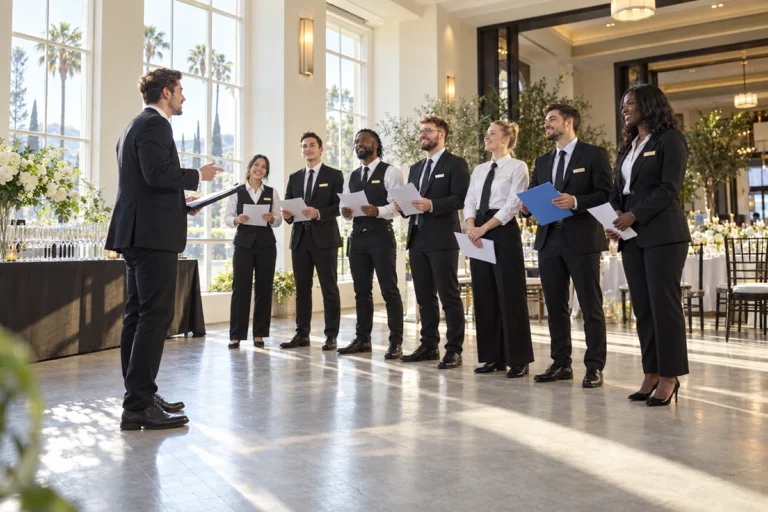
Staffing doesn’t fail on show day. It fails in the briefing.
Briefing is where reliability turns into performance. Even the best staff fail with a vague brief. Clear inputs create consistent outputs. That’s not theory, it’s floor math.
15-Minute Pre-Show Briefing Agenda
- 2 min: Brand positioning + what not to say.
- 3 min: Opener + two qualifier questions (e.g., “What brought you to the show?” + “What’s your timeline?”).
- 3 min: What counts as a qualified lead (examples help).
- 3 min: Demo flow + when to pull in internal SMEs.
- 2 min: Lead capture standards (notes, tags, lead grade).
- 2 min: Escalation plan (VIPs, tough questions, issues).

Frequently Asked Questions
How many staff do I need for my trade show booth?
Staffing ratios depend on booth size and traffic. A solid baseline is 1-2 people per 100 sq ft, plus 20-25% extras for breaks. We often recommend using trade expo staff specialists who are accustomed to high-density environments. For high-traffic setups, add a supervisor to maintain lead capture workflows without overwhelming your internal team or leaving zones purely unguarded during lunch rotations.
How do I vet trade show staffing agencies for reliability?
Demand staff profiles with photos and resumes, a clear replacement timeline (under 30 minutes), and proof of lead qualification training. When you hire booth staff, avoid agencies that give vague answers about sourcing or lack supervisor options. Reliable agencies share artifacts like past client references and briefing workflows, ensuring the team you get matches the specific energy your brand requires.
What are red flags when hiring trade show staffing companies?
Avoid agencies that won’t provide profiles or dodge questions on lead capture processes. This often indicates a lack of B2B experience, which is risky when you staff corporate events where professionalism is non-negotiable. Other warnings include last-minute availability only, no multilingual options, or evasive onboarding details. Reliable providers prioritize show-floor experience over generic event work to ensure pipeline integrity.
How far in advance should I book trade show booth staffing?
Start 2-4 weeks ahead to secure quality talent. This is vital when you hire brand ambassadors who are in high demand during peak seasons like CES. Booking late often spikes costs by 20-50% and limits your selection to less experienced staff. Early planning allows for proper vetting, profile review, and the implementation of a hybrid model if needed.
How do I train booth staff for strong lead generation?
Run a strict 15-minute pre-show briefing covering openers, qualifiers, and handoffs. Utilizing experienced hire event greeters can streamline this, as they already understand traffic flow mechanics. Assign roles by personality: greeters for the pull, qualifiers for screening, and conduct daily resets to fix weak spots. This structure turns your staffing investment into a verifiable pipeline machine rather than just a physical presence.
What to Do Next
Good staffing reduces risk. Great staffing protects lead quality, stabilizes costs, and keeps your booth performing even when traffic spikes. The real difference-maker, especially on multi-day shows, is supervision, clear roles, and a plan for what breaks.
If your next show matters to pipeline, brand perception, or executive confidence, this is not an area to gamble. Get a quote to secure coverage that performs like an engineered system, not a roll of the dice.
Are You Ready to Elevate Your Event?
Don’t wait—book Premier Staff now to secure top-tier professionals for your next event.
Recommended Posts


An event brand ambassador is the person who represents your brand to guests from setup to wrap-up. Before your event,...