
- Luxury Hospitality Talent: Micro-Behaviors That Win

Luxury hospitality talent is defined by the invisible micro-behaviors that regulate guest perception under pressure. In high-stakes settings like fashion launches or private equity dinners, a single rushed movement can dismantle the premium atmosphere instantly. Standard teams often fail within the first sixty seconds of arrival because they prioritize task speed over the operational stillness required to keep VIPs at ease. True authority comes from mastering breath pacing, gesture precision, and discreet communication protocols that remain undetectable to the guest. We examine exactly how these mechanics protect your brand tone.
Executive Summary
Luxury hospitality talent is defined by micro-behaviors that regulate guest perception before a word is spoken: stillness, breath pacing, object control, and discreet communication. When producing fashion, spirits, or private-equity events, these behaviors reduce guest friction, protect brand tone, and prevent escalation loops.
I don’t sell luxury as a wardrobe upgrade, because luxury fails when staff behavior becomes visible under pressure. I select and train luxury hospitality talent to control cadence, posture, and discreet communication, then I audit execution in real time. That’s how I protect brand tone and keep producers out of escalation loops.
— Daniel Meursing, CEO of Premier Staff
What Luxury Hospitality Means Beyond “Good Service”
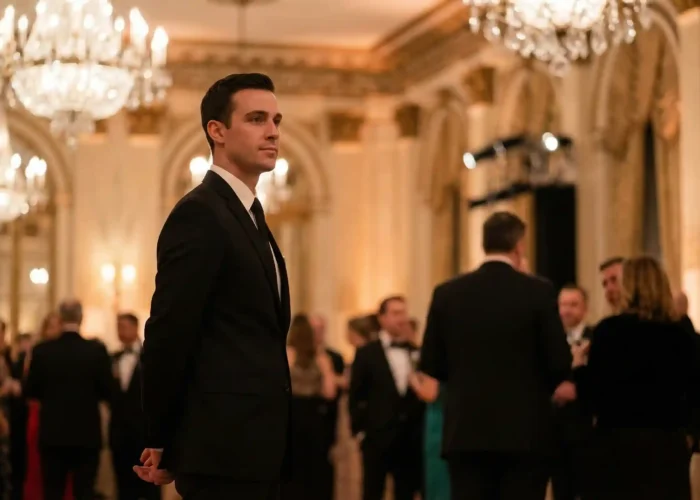
Luxury service is often misunderstood. Planners focus on what the staff does, but the real differentiator is what the guest never experiences: awkwardness, correction, visible stress, or the subtle sense of being managed. Luxury is behavioral control executed quietly enough that it feels like intuition.
That is why luxury hospitality talent doesn’t chase applause. It prevents social friction before it forms. In premium environments, the cost of a social misstep is higher than the cost of a short delay. If service is fast but the guest feels watched or rushed, you lose. That loss rarely shows up as a “service issue”; it shows up as brand doubt.
Experience vs. Execution
“Good service” completes tasks. It delivers the drink or finds the coat check. Luxury hospitality talent completes the same tasks while reducing perceived friction through timing and voice discipline.
Consider a guest looking for the restroom:
- Standard Staff: Steps forward quickly, points aggressively, and explains loudly.
- Luxury Talent: Notices the wandering eye, approaches diagonally, gives one clear sentence in a low tone, and disengages cleanly.
The outcome is the same, but the perception is entirely different. This nuance is why knowing how to elevate guest experience requires looking at the “how,” not just the “what.”
Micro-Behaviors Guests Instantly Recognize
Guests register micro-behaviors in 5–8 seconds. This isn’t abstract branding theory but a core principle of sensory marketing science, detailing how humans scan for competence and safety in unfamiliar environments.
Facial Neutrality and Soft-Smile Discipline
High expressiveness reads as performance. Over-smiling invites boundary testing or casual disrespect. When you hire event hostesses, they must use “soft-smile discipline, a look that communicates calm warmth without chasing approval. Failure often looks like staff laughing too hard at a guest’s joke, which shifts the dynamic from professional to “buddy,” causing authority to collapse.
Precision in Hand Placement
Hands are where uncertainty leaks. Floating hands, fidgeting, or searching gestures create “visual noise.”
Luxury staff keep their hands quiet:
- One controlled gesture, then stop.
- Objects held still, not adjusted mid-action.
- No tight clasping in front of the body (the “fig leaf” pose).
Stillness When Idle
Stillness is a premium signal because it implies control. Staff who sway or scan aggressively raise guest vigilance. Luxury stillness involves grounded feet, relaxed shoulders, and minimal head movement. This anchors the room visually.
Tone, Pacing, and Breath Control
You can train phrases, but you cannot hide a nervous system. If a staff member sound rushed, the guest feels processed. Luxury hospitality talent is nervous system regulation in uniform.
Slowed Speech Cadence
The standard for luxury is a speech cadence 10–20% slower than conversational speech. Speed reads as panic or sales energy. Even when time is compressed, such as during a toast or a stage transition, luxury staff shorten the sentence, not the breath.
Neutral Energy Distribution
A common failure pattern is mirroring. If a guest is intense, standard staff become intense. When you hire luxury bartenders, they must hold “energy neutrality.” They let the guest’s intensity hit a stable surface, de-escalating the moment without confrontation.
Presentation and Aesthetic Symmetry
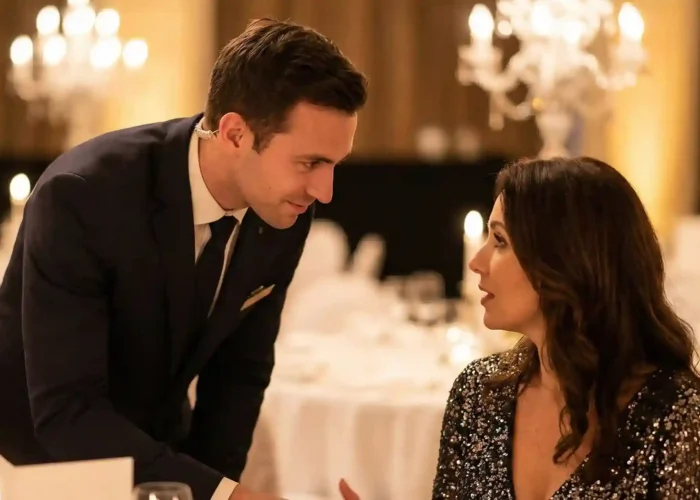
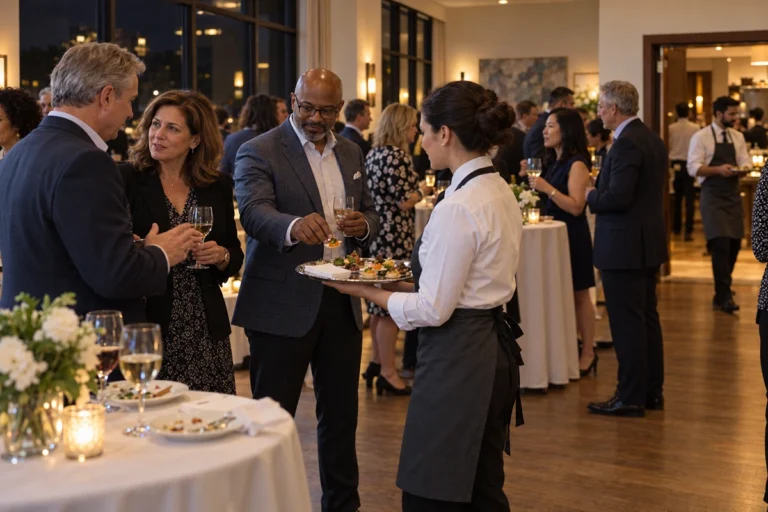
Luxury is visual before it is verbal. If staffing looks inconsistent, the event feels cheaper. This is why you hire model staff, not just for their look, but for their ability to maintain uniform posture and spacing.
Tray Alignment & Posture
Tray wobble kills luxury perception. Rebalancing a tray mid-room signals inexperience. Luxury discipline dictates that trays remain level and are only reset in back-of-house zones. Similarly, posture must be consistent across the team. Hunching or leaning on one leg reads as informal, inviting guests to cross professional boundaries.
For a deeper dive on maintaining visual standards, review our luxury planning checklist.
Discreet Communication Techniques
Luxury rooms punish visible coordination. The moment staff huddles or whispers loudly, trust drops. Luxury hospitality talent uses micro-signaling to coordinate without breaking the illusion of ease.
- Eye-Line Signaling: A glance at a captain replaces a verbal “Is it okay to move?”
- Micro-Nods: Tiny, directional acknowledgments that confirm a task without greeting the colleague.
- Non-Verbal Hazard Alerts: Using body placement to block a spill rather than shouting for cleanup.
Effective crowd control staff in luxury spaces rely entirely on these non-verbal cues to redirect traffic without making guests feel herded.
Subscribe To Our NewsLetter
We help you to elevate your events with our highly skilled professionals. You got these three simple steps to book our service
Why These Behaviors Cannot Be Taught Overnight
People ask for luxury staffing like it’s a wardrobe upgrade. It isn’t. These behaviors are muscle memory. Under fatigue, default behaviors return. A realistic benchmark is 200+ repetitions for tray hold neutrality alone.
2026 Labor Reality
As luxury experience trends shift toward hyper-personalized service, the cost of this consistency is rising due to tighter union enforcement in major markets like New York and Chicago. Training time is now a billable necessity. Agencies that claim to provide “luxury” without paid rehearsal time are setting you up for a degradation of service in the final hours of the event. For a breakdown of who is investing in this training, see our top staffing agencies list.
How Premier Staff Trains and Selects Luxury Talent
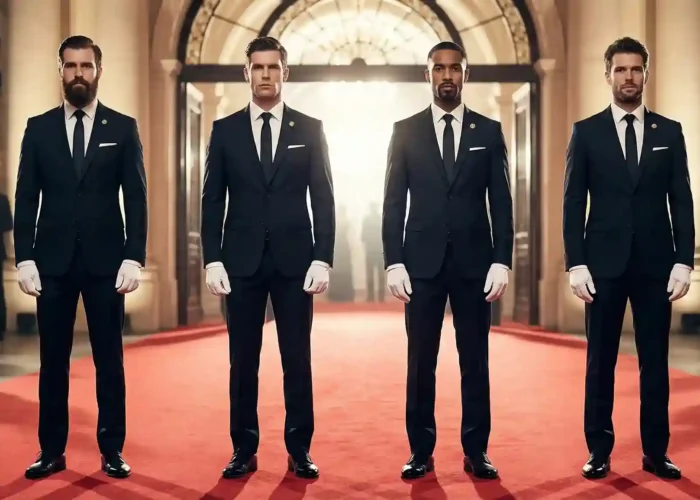
We treat luxury as a behavior-specific performance. Our New York hostesses undergo audits for pacing, tone, and phrase discipline.
Micro-Audits and Captains
A strong captain does three things in a luxury room:
- Assigns one staffer to stabilize tone at pinch points.
- Moves operational issues off the guest’s field instantly.
- Keeps coordination discreet so the room never sees the adjustment.
Cost Logic: The Fast Estimate
Luxury staffing budgets drift when planners treat “staff” as a flat line item. Here is the planning model:
- Minimum Calls: Expect 4–5 hour minimums in major metros to secure top-tier talent.
- Captain Ratio: 1 captain per 10–14 staff is the floor for luxury FOH coverage.
- Complexity: Gifting, split flows, and press moments require rehearsal time, not just call time.

Frequently Asked Questions
Do luxury staff need different training for fashion vs. corporate events?
Yes. Fashion events require movement symmetry, sightline awareness, and the ability to scan guests without looking like security. Corporate luxury, especially for private equity or board dinners, requires authority, absolute privacy, and a calm cadence. We often deploy private event staff specifically trained in non-disclosure and discretion for corporate functions, whereas fashion events may utilize talent focused more on visual presentation and rapid flow management.
Can luxury hospitality talent be added last-minute?
It depends on the market and the role. You can often add bodies, but behavioral consistency is harder to secure within 48 hours. Late additions also trigger minimum calls and can weaken the captain-to-staff ratio. If you must add talent late, we recommend adding event server teams for back-of-house support to free up your best core team members for guest-facing interactions, ensuring the front-of-house standard remains high.
How do you audit micro-behavior quality mid-event?
We use “reset zones” for correction. Captains run micro-audits on posture, tone, and object handling while staff are in motion. However, they never correct a staff member in front of a guest. Instead, the staff member is rotated into a back-of-house or reset zone for a 30-second coaching adjustment. This preserves the “theater” of the event while ensuring standards are maintained. Check-in staff teams are monitored most closely as they set the initial tone.
What’s the biggest failure pattern with standard staff at luxury events?
The most common failure is visible urgency. It manifests as rushed speech, fidgeting, over-smiling, and staff clustering in corners. Guests read this behavior as uncertainty or anxiety, which prompts them to test boundaries or escalate requests. Professional waitstaff teams are trained to maintain a “quiet floor,” meaning no visible huddles and a deliberate reduction in movement speed when the room gets busy, counter-intuitively calming the environment.
Do premium hospitality teams reduce guest complaints measurably?
Yes, significantly. Complaints drop because guests feel respected and guided rather than “handled.” The biggest reduction is found in tone-related complaints, which are notoriously difficult to fix with logistics alone. By utilizing teams and choosing to hire brand ambassadors who are trained in emotional intelligence and conflict de-escalation, you prevent the small social frictions, like a misinterpreted look or a rushed answer, that typically turn into negative post-event feedback.
Why Stability Outperforms Charisma
Luxury doesn’t reward charisma; it rewards consistency. When the room tightens, luxury hospitality talent doesn’t flinch. This stability is what protects the producer from emotional event management and drives repeated bookings. To ensure your broader operations match this level of service detail, explore our insights on designing brand experiences to lock in your standards before the doors open.
Are You Ready to Elevate Your Event?
Don’t wait—book Premier Staff now to secure top-tier professionals for your next event.
Recommended Posts
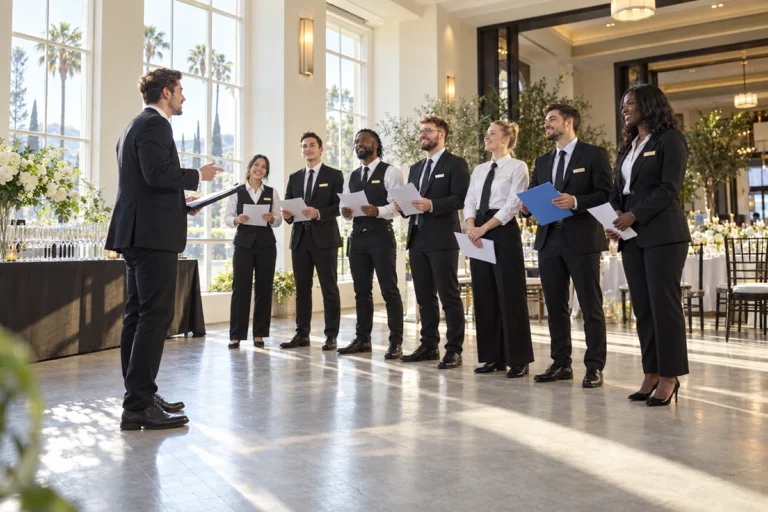
An event brand ambassador is the person who represents your brand to guests from setup to wrap-up. Before your event,...