

Daniel M., CEO - Premier Staff
Want to Elevate Your Brand Ambassador Staffing Agency NYC Plans?
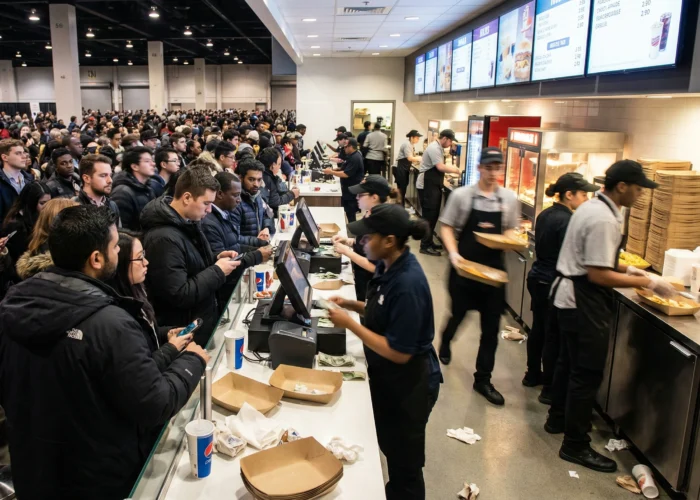
Most concession setups are built for average flow, not peak demand. But events don’t run on averages everything happens in spikes, and that’s where staffing either holds or breaks.
Executive Summary
Concession stand staffing is the team responsible for handling food, beverages, and customer flow at events like stadiums, festivals, and large venues. This includes cashiers, food prep staff, runners, and supervisors working together to serve guests quickly and efficiently.
In most events, staffing falls between 1 staff per 40–100 guests, depending on service type, menu complexity, and traffic patterns. Use the calculator below to estimate your exact team size and understand how concession staffing works in real event environments.
How Many Concession Stand Staff Do You Need for an Event?
If you’re planning a stadium event, festival, or large venue activation, getting concession stand staffing right is critical.
Concession staffing is not just about assigning people to a booth. It’s about managing food prep, payments, and customer flow during high-pressure peak periods. When staffing is off, even slightly, lines slow down, orders get missed, and guest experience drops.
In most events, teams underestimate staffing needs by 20–30%. This single mistake is one of the biggest reasons concession operations fail under pressure.
Who Makes Up a Concession Team?
A typical concession team includes:
- Cashiers → take orders and handle payments
- Food prep staff → prepare and assemble items
- Runners → manage flow and restocking
- Supervisors → oversee operations and fix issues
The exact mix depends on your event size and service type.
Fun fact: Perceived waiting time is often longer than actual waiting time. A 5-minute wait feels like 10 minutes when there’s no communication or visible movement. This is why perceived wait time matters more than real wait time in guest satisfaction.
Staffing Calculator: Get Your Number
Step 1: How many guests are you expecting?
Enter your total number
Example: 500 guests
Step 2: Pick your service style
Choose the one that matches your setup:
- Self-serve (grab & go)
- Limited menu (3–5 items)
- Full menu (made-to-order)
- Bar / cocktail service
Step 3: Get your base staff number
Use this quick guide:
- Self-serve → 1 staff per 100 guests
- Limited menu → 1 staff per 75 guests
- Full menu → 1 staff per 50 guests
- Bar service → 1 staff per 40 guests
Example:
500 guests + full menu → 500 ÷ 50 = 10 staff
Step 4: Adjust for your event setup
Now adjust your number slightly:
- Simple setup (one stand) → no change
- Multiple stations → add 10–15% more staff
- Busy / peak event → add 15–25% more staff
Example:
10 staff + busy event → add ~20% → 12 staff total
Your Estimated Staffing
- Self-serve: 1 staff per 90–100 guests
- Limited menu: 1 staff per 70–80 guests
- Full menu: 1 staff per 45–55 guests
- Cocktail/bar: 1 staff per 35–45 guests
👉 Multiply based on your guest count 👉 Then adjust for complexity
Real Event Examples
Stadium Event (High Traffic)
5,000 guests, limited menu
- Base: 1 per 75 guests → ~65–70 staff
- Add 20% peak load → 80–85 staff
→ Peak demand hits all at once. Stadium crowd flow management shows that arrival clustering when most guests show up within a narrow time window requires significantly higher staffing density than the average guest count would suggest.
Corporate Event (Predictable Flow)
500 guests, buffet-style
- Base: 1 per 60 guests → ~8–9 staff
- Add a small buffer → 9–10 staff
→ More controlled timing = fewer staff needed. (See how corporate events scale differently.)
Festival (Multiple Stands)
2,000 guests, 4 food stations
- Base: ~25–27 staff total
- Per station: 6–7 staff
→ Traffic spreads out, reducing pressure per stand.
Random insight: Festival-goers are more forgiving of wait times than stadium guests because they control their own pace. They’re not time-bound by a kickoff or keynote. This psychological difference means you can staff slightly lighter at festivals than at structured events, but don’t push it too far.
Food Safety Standards
If you’re serving food at your event, staff must follow federal food safety guidelines. Key standards include:
- Temperature control (hot food above 140°F, cold food below 40°F)
- Proper handling and storage
- Cross-contamination prevention
- Time limits for food sitting at room temperature
Make sure your concession staff is trained on these before the event starts.
When You Need More Staff
Add more staff if:
- Lines exceed 5 minutes (this is the frustration threshold)
- Multiple food stations need coverage
- Alcohol is served (+20–30%)
- High-traffic events (concerts, sports)
- VIP or premium sections require faster service
If unsure, slightly overstaffing is safer than falling behind.
The break math nobody accounts for: Federal labor law varies by state on break requirements, but most states require a 10-minute break for every 4 hours worked. Budget an extra 10–15% staff just for breaks and restroom coverage. A 10-person team actually needs 11–12 total people to account for rotation.
Why Staffing Levels Directly Impact Revenue
According to industry research, reducing wait times by even 1–2 minutes can significantly increase per-guest spending at high-volume events.
When lines move faster:
- Guests are more likely to make repeat purchases
- Abandoned queues decrease
- Overall concession revenue increases
This is why experienced planners prioritize concession staffing efficiency, not just cost control.
How to Reduce Staffing Costs Without Hurting Service
- Pre-prep everything possible: Items made off-site = faster assembly = fewer cooks needed.
- Simplify the menu: 3 items instead of 10 reduces decisions, prep time, and complexity; subtract 1–2 staff per stand.
- Use self-serve where possible: Guests grab their own drinks/sides; subtract 1–2 staff per stand.
- Cross-train runners as cashiers: One person can handle multiple roles during low-traffic periods.
- Stagger shifts: Instead of 8 staff for 8 hours, use 4 staff for 4 hours (peak only) + 2 staff for 4 hours (off-peak).
- Use POS or mobile ordering: Reduces wait, increases throughput; can subtract 1 cashier.
Get the Right Concession Staff for Your Event
If you’re planning a high-traffic event, the difference between smooth service and long lines comes down to execution.
Our team specializes in concession stand staffing for large-scale events, with trained staff who perform under peak pressure.
👉 Get a custom staffing estimate based on your event size and setup
👉 Or speak with our team to plan your concession operations end-to-end
Contact us today to hire concession stand staff who can deliver at scale.
How many concession stand staff do I need per guest?
Most events require 1 concession staff per 40–100 guests, depending on menu complexity and service style. High-traffic events like stadiums or concerts usually need more coverage. Premier Staff’s Stadium Event Staff can help you scale your concession team to match attendance and demand.
What roles are included in concession stand staffing?
A typical concession team includes cashiers, food prep staff, runners, and supervisors, each keeping operations fast and efficient. Premier Staff’s Catering Staff are trained across all concession roles to keep your event running smoothly.
How can I reduce concession staffing costs without affecting service?
Simplifying your menu, using pre-prepared items, and cross-training staff can significantly cut costs without sacrificing quality. Premier Staff’s Hospitality Staff are cross-trained professionals who adapt across multiple roles, making them a cost-effective concession solution.
When should I hire additional concession staff for an event?
Increase staffing for high-traffic events, alcohol service, multiple stations, or VIP areas. If wait times exceed 5 minutes, you need more staff. Premier Staff’s Bartenders and Catering Staff are available for high-demand and multi-station setups.