

Daniel M., CEO - Premier Staff
Want to Elevate Your Brand Ambassador Staffing Agency NYC Plans?
Most festivals don’t fail because they lack staff. They fail because their festival staffing plan doesn’t account for human limits. If your structure depends on people pushing through fatigue, your event will always decline after Day 1.
Stop Day-2 Burnout in Festival Staffing
Executive Summary
If your festival staffing feels great on Day 1 and falls apart by Day 2, you don’t have a staff problem; you have a structure problem. Most planners try to fix burnout by adding more people, but that doesn’t work. The real fix is a smarter music festival staffing solution built on rotation. This guide shows exactly how to structure multi-day event staffing, so your team stays sharp, your guests stay happy, and your event doesn’t decline halfway through.
Festival Staffing Problem: Why Day-2 Burnout Happens
Let’s put it simply.
You can’t run festival staffing on 12–16-hour shifts across multiple days and expect consistency.
By Day 2:
- energy drops
- mistakes increase
- service slows
Quick reality: No multi-day event staffing setup survives without rotation. Research shows that in preventing venue staff burnout, the physiological impact is unavoidable.
And here’s the kicker: guests notice immediately.
Not “something feels off.”
More like: “Why is everything slower today?”
That’s your brand taking the hit. It’s why experienced event staffing agencies prioritize rotation planning.
Music Festival Staffing Solution: Introduce Rotation Early
Most planners think: “Let’s just add more staff.”
Wrong move.
More people don’t fix fatigue. A structured music festival staffing solution does.
The fix is simple: 👉 A 3-team rotation plan (6-on, 2-off concept)
This is the backbone of strong festival staffing. Proper shift scheduling and crew rotation is what separate successful events from burnout crises. When you partner with expert hospitality staff services, they build this structure into your plan from day one.
Festival Staffing Plan: The 3-Team Rotation That Works
Here’s how smart festival staffing actually works.
Divide your team into 3 groups:
Team | Day 1 | Day 2 | Day 3 |
Group A | Work | Work | Off |
Group B | Off | Work | Work |
Group C | Work | Off | Work |
This structure creates a reliable multi-day event staffing rhythm.
Why this works:
- no back-to-back burnout
- consistent energy across days
- predictable staffing coverage
What most people miss: A proper music festival staffing solution is about maintaining Day-1 energy on Day-3. Professional catering and staffing services understand this rhythm and build schedules around it.
Festival Staffing Cost Impact: What Burnout Really Costs
Let’s talk money.
Bad festival staffing doesn’t just look bad; it costs you. As covered in solving the festival staffing crisis with retention strategies, burnout directly impacts your bottom line:
- slower service → fewer transactions
- mistakes → refunds
- poor experience → lost repeat guests
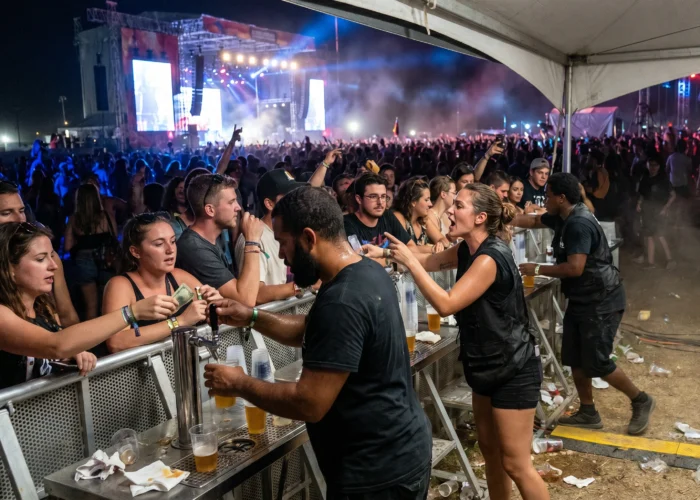
Example: 4 bartenders
- Day 1 → 150 dri nks each
- Day 2 → 120 drinks
- Day 3 → 80 drinks
That’s a 40–50% drop in output.
Now multiply that across your entire multi-day event staffing setup. Understanding your staffing cost structure upfront helps you plan smarter.
Fun fact: Guests judge service quality within the first 15 minutes of interaction. Burnout shows instantly.
Music Festival Staffing Solution in Action (Real Example)
Rainbow Serpent Festival (Australia) – A/B Team Rotation
Rainbow Serpent Festival implemented a proven rotation system where the production crew was split into Team A and Team B. While Team A rested, Team B worked. The teams swapped every 6-8 hours, ensuring everyone got downtime even during the 24-hour production cycle. This structured rotation prevented the Day-2 collapse that typically impacts multi-day festivals. Staff maintained consistent energy, mistakes stayed low, and guest satisfaction remained high through closing night.
Result:
- No significant drop in service quality by Day 2
- Crew reported higher morale and less burnout
- Event operations remained smooth across all three days
That’s what optimized festival staffing looks like. When you work with an experienced event staffing agency, you get these proven systems built in.
How to Implement Festival Staffing Rotation Properly
Here’s the simple version.
If you’re building festival staffing, do this:
- Divide staff into 3 groups
- Assign each group one rest day
- Rotate heavy and light shifts
- Keep experienced staff on peak hours
- Monitor energy daily
That’s it.
That’s a real music festival staffing solution. When you partner with brand ambassadors and event staffing experts, they handle the logistics, so you focus on guest experience.
Multi-Day Event Staffing Reality: One Day Off Isn’t Enough
Here’s where most planners mess up.
They give: → one day off
And expect recovery.
Doesn’t work.
In multi-day event staffing, recovery needs consistency, not randomness. As research on peak season staffing shows, your best people won’t make it through without proper rotation.
Two-day spacing (via rotation) works.
One-day breaks don’t.
Festival Staffing: Rotation vs No Rotation
Factor | No Rotation Plan | Rotation Plan (3-Team Model) |
Staff Energy | Drops by Day 2 | Stable across all days |
Service Speed | Declines | Consistent |
Error Rate | Increases | Controlled |
Guest Experience | Inconsistent | Reliable |
Revenue Performance | Declines daily | Sustained |
This is why professional music festival staffing solutions always prioritize structured rotation over headcount expansion.
Final Take: Festival Staffing Is About Consistency
Let’s be honest.
Anyone can make Day 1 feel great.
The real test of festival staffing is:
👉 Does Day 3 feel the same?
If your music festival staffing solution is:
- reactive
- unstructured
- based on hope
You’ll see the drop.
If your multi-day event staffing is:
- planned
- rotated
- balanced
Your event holds strong.
Build Your Festival Staffing the Right Way
Don’t guess your festival staffing.
👉 Event size + days = optimized rotation plan
Get a tailored music festival staffing solution that actually works.
We specialize in multi-day events. Here’s how to get started:
- View our festival staffing expertise across major cities
- Check our pricing and staffing costs upfront
- Learn about our team and approach to rotation planning
- Contact us today for a tailored consultation
Your guests (and your staff) will feel the difference by Day 2.
What is the best festival staffing strategy to prevent burnout?
The best festival staffing strategy is to use a structured rotation plan, such as a 3-team system. A strong music festival staffing solution ensures staff get proper rest, which keeps energy consistent across all days in multi-day event staffing.
How does a music festival staffing solution improve staff performance?
A proper music festival staffing solution improves performance by balancing shifts and reducing fatigue. When festival staffing is planned with rotation, staff stay alert, make fewer mistakes, and deliver a better guest experience throughout the event.
Why is rotation important in multi-day event staffing?
Rotation is critical in multi-day event staffing because continuous long shifts reduce energy and increase errors. A structured festival staffing rotation ensures staff recover properly and maintain consistent service quality.
What happens if festival staffing does not include a rotation plan?
Without a rotation plan, festival staffing quickly leads to burnout. Staff performance drops, guest experience suffers, and mistakes increase. This is why every music festival staffing solution should include a clear rotation structure.