

Daniel M., CEO - Premier Staff
In the high-stakes world of US events, the difference between a service error and a service recovery is training. Premium hospitality event staff in US markets function as brand guardians, using emotional intelligence and technical precision to ensure that operational friction never reaches the guest experience.
Want to Elevate Your Brand Ambassador Staffing Agency NYC Plans?
Your event deserves the best partner with Premier Staff for top-tier Brand Ambassador Staffing Agency NYC
Hospitality event staff in US markets require precision training in service sequencing, VIP etiquette, and conflict de-escalation to handle high-stakes activations. When you’re managing a 500-guest gala, simple availability isn’t enough; you need teams that master synchronized table pacing and ADA compliance to prevent visible service gaps. Premium staff rely on these specific modules to ensure operational friction remains invisible to the guest. Let’s break down the training pillars that ensure reliability.
Executive Summary
In luxury events, labor is the single biggest variable that can ruin a six-figure production budget. Premium hospitality event staff in US markets are defined by advanced competencies in sequencing, tone management, and risk mitigation, ensuring brand safety during high-pressure activations. This guide details the specific training modules that separate elite teams from general labor.
Core Training Modules for High-End Hospitality Teams
When you hire hospitality event staff in US cities for a high-stakes function, you are investing in operational risk mitigation. Standard staffing agencies often overlook the nuances of “invisible service,” leading to gaps, like cluttered tables or congested entryways, that become glaringly obvious once the room hits capacity.
To ensure consistency, elite staffing partners focus on five critical training pillars that align with ADA.gov accessibility standards and luxury service protocols:
Module | Focus | Operational Outcome |
Service Sequencing | Clockwise Mechanics + Sweep Timing | Entire 10-top tables served in <90 seconds; hot food integrity maintained. |
VIP Etiquette | Non-Verbal Recognition + Preference Tracking | C-suite/talent feel prioritized without “fan” friction or conversational interruption. |
Conflict Resolution | Isolation Tactics + L.A.S.T. Protocol | Liability risks (e.g., intoxication) neutralized quietly without causing a “scene” or disrupting flow. |
ADA Awareness | Pathway Clearance (36″) + Service Animal Laws | Full legal compliance + dignified, equitable access for guests with mobility or sensory needs. |
Brand Tone | Vocabulary Inhibitors + Posture Calibration | Staff mimic internal culture (e.g., “Guest” vs. “Customer”), appearing as employees rather than temps. |
These modules transform individual workers into a cohesive tactical unit capable of absorbing the unpredictability of live events.
Pro Tip: The Hidden Cost of the Gig Economy
When comparing staffing options, the price gap often reflects a risk gap.
- Gig App Labor: Vetted by algorithm, arrives “cold” without briefing, high variance in service quality.
- Premium Event Staff: Vetted by human operations teams, arrives with site-specific “Run of Show” knowledge and consistent brand alignment.
While gig labor may save 15% on the hourly rate, a single service failure, like spilling a drink on a VIP or mismanaging an allergen, can cost a client thousands in reputational damage.
Why Service Sequencing Is the Foundation
Service sequencing is the technical backbone of any premium event. It separates a chaotic dinner from a choreographed experience. Hospitality event staff in US venues must master “open-handed service”, placing plates from the left and clearing from the right using an open palm to avoid crossing the guest’s sightline.
For a 500-guest gala, synchronization is non-negotiable. Staff must coordinate with floor captains to ensure Table 1 and Table 50 receive entrées within the same 12-minute window. This requires training in “table pacing”, reading the room’s eating speed and signaling the kitchen to fire courses accordingly. As discussed in our analysis of Best GP Afterparties, when sequencing fails, food runs cold, run-of-show schedules slip, and the event feels operationally disjointed.
When you spend $200 per plate on catering, a slow server effectively devalues that investment by delivering a lukewarm product. Premium staffing ensures your catering budget yields maximum guest satisfaction.
Soft Skills That Distinguish Premium Staff
Technical skills execute the task; soft skills protect the brand. The best hospitality event staff in US markets possess high emotional intelligence, allowing them to read micro-expressions and anticipate needs before they are verbalized.
- Composure Under Pressure: The discipline to remain neutral and efficient when a tray drops or a timeline collapses.
- Anticipatory Service: Pouring water before the glass is empty or offering a napkin before the guest realizes they need one.
- Verbal Precision: Eliminating casual fillers. It is never “No problem” or “Yeah”; it is “Certainly,” “My pleasure,” or “I will find out immediately.”
High retention rates in staffing often correlate with better soft skills. For deeper insight, read Staff Retention Strategies to understand how experienced teams bring stability to the floor.
Training for Multi-Zone or Large-Scale Events
Managing a single room is standard; managing a multi-zone activation requires logistics. Hospitality event staff in US conventions often coordinate across sprawling venues like the Javits Center or McCormick Place.
Training for these environments focuses on communication hygiene. Staff learn specific radio protocols (using “10-codes” or strict earpiece etiquette) to keep channels clear for urgent updates. They practice “zone defense,” ensuring coverage overlaps during shift changes so no VIP section is left unmonitored. For high-volume bar service, training emphasizes “speed pouring” and “eye-contact queuing”, acknowledging the fourth person in line while serving the first, to keep wait times under four minutes.
How Premier Staff Develops Premium Hospitality Talent
At Premier Staff, we don’t just find people; we build teams. Our development pipeline for hospitality event staff in US regions involves a multi-stage audit, mirroring Harvard Business Review best practices for high-performance service teams. It begins with behavioral interviews to assess attitude, followed by practical service drills where candidates must demonstrate tray stability (carrying 8+ stems) and proper wine service mechanics.
We utilize scenario-based stress testing. Candidates are evaluated on how they handle specific friction points, such as refusing service to an intoxicated VIP or managing a dietary restriction mid-service. Only those who demonstrate quick, brand-safe thinking make our active roster. This rigor ensures that when hospitality event staff in US teams arrive on-site, they are plug-and-play assets, not liabilities.
Ready to Deploy Elite US Hospitality Teams?
The difference between a passable event and a memorable one often lies with the frontline. Hospitality event staff in US markets must be more than present; they must be operationally invisible yet immediately available. By investing in comprehensive training, from technical sequencing to emotional intelligence, you ensure your event runs on rails, your brand is protected, and your guests leave impressed. Whether you are planning a corporate summit or a private gala, securing hospitality event staff in US regions with this pedigree is essential. If you are ready to secure your team, you can Get a Quote right now to ensure your holiday event is fully covered.
Is specific training required for hospitality event staff in US luxury events?
Yes. Luxury events demand a higher tier of hospitality event staff in US training, focusing heavily on VIP protocol, discreet service (invisibility), and non-verbal communication cues. High-net-worth guests expect recognition without intrusion. Our Event Hostess Teams are specifically trained to manage these sensitive interactions, ensuring that VIPs feel prioritized and secure throughout the event duration.
How does ADA awareness impact event staff performance?
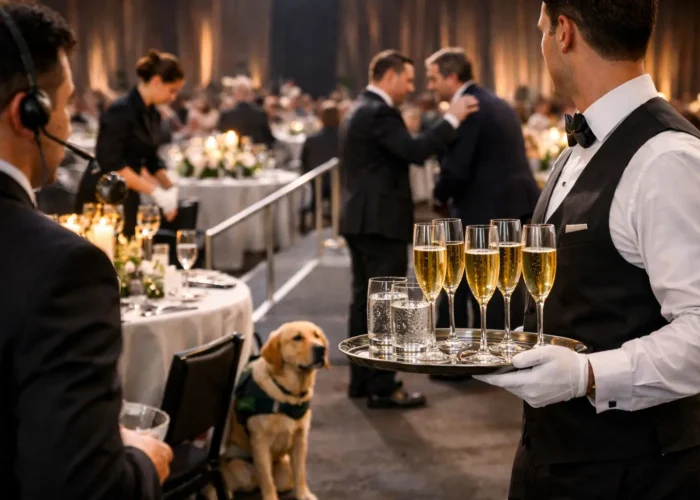
ADA training ensures that hospitality event staff in US venues proactively assist guests with disabilities, from clearing wheelchair-accessible routes to understanding service animal protocols, ensuring legal compliance and genuine inclusivity. For detailed compliance, we refer to federal accessibility guidelines. Our Event Usher Services are drilled in these specifics to ensure every guest navigates the venue safely and comfortably.
Can hospitality event staff handle security functions?
While hospitality event staff are trained in situational awareness and conflict resolution, they are not security guards. Their role is to identify risks (intoxication, aggression) and report them to dedicated security teams. However, our Crowd Control Teams bridge this gap, managing flow and de-escalating non-violent friction points to maintain a safe environment without creating a “police state” atmosphere.
What is the typical ratio for staff to guests in a formal dinner?
For a plated dinner, the standard for hospitality event staff in US events is one server per 10-12 guests (1:10). For VIP functions with intricate service steps or multiple wine pairings, this ratio tightens to 1:8 to ensure precision. Our Professional Event Waitstaff are accustomed to these tighter ratios, ensuring synchronized service that keeps the run-of-show perfectly on time.