

Daniel M., CEO - Premier Staff
Want to Elevate Your Brand Ambassador Staffing Agency NYC Plans?
Most events don’t feel understaffed at the start; they feel it during transitions. The gap shows when plates aren’t cleared fast enough, or drinks stop moving. Getting the server-to-guest ratio right isn’t about numbers; it’s about making sure nothing breaks under pressure.
How Many Servers Do You Really Need for 100 Guests?
Executive Summary
how many servers for 100 guests, most planners need 6–8 professional servers to maintain smooth, consistent service. This range is based on standard hospitality benchmarks, where staffing varies by service style:
- Plated dinners: Higher staffing (1:10–1:12) to ensure timing and presentation
- Buffets: Moderate staffing (1:15–1:20) focused on clearing and reset
- Cocktail events: Lower staffing (1:20–1:30) with emphasis on circulation
The right number isn’t just about coverage, it’s about maintaining service flow during peak moments like course transitions, drink refills, and table resets. Understaffing typically becomes visible not at the start, but when timing matters most.
The Short Answer: How Many Servers for 100 Guests
If you just want the number: → 100 guests = 6–8 servers
That’s your baseline. Most events settle around 7 servers. When calculating how many servers for 100 guests, remember that the server-to-guest ratio is critical. Industry research shows the average baseline ratio is one server per 32 attendees, though this is inadequate for most situations where you want guests to remember the service positively.
The Core Formula: Calculating Server-to-Guest Ratio for 100 Guests
A practical baseline used by experienced event planners is the following:
→ Divide total guest count by 14–16 guests per server
This gives you a working range of 6–8 servers for most events.
However, this formula assumes:
- Active table service (not self-service)
- Continuous clearing and resetting
- Moderate guest interaction (water, wine, basic service)
For higher-touch events like multi-course plated dinners, planners often tighten this ratio to maintain synchronized delivery and temperature control, especially when serving large tables simultaneously.
What This Looks Like in Practice
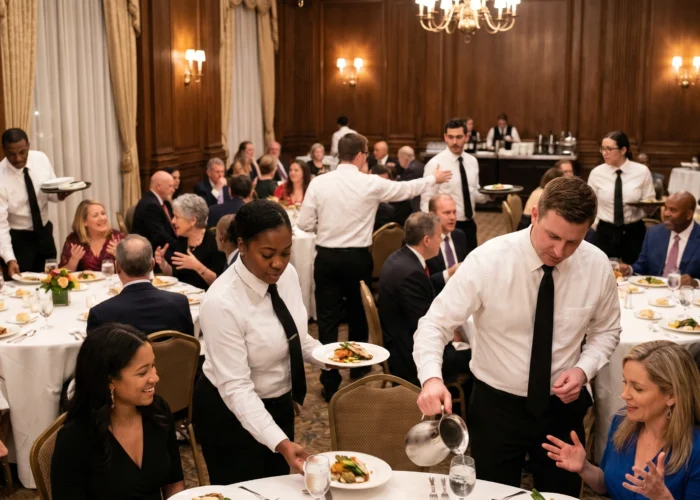
Imagine a 100-guest corporate dinner with a three-course plated menu:
- With 6 servers, service slows during transitions, and guests wait for clearing and refills
- With 8 servers, courses are delivered within tight windows, tables are reset quickly, and service feels seamless
This difference is subtle operationally but highly visible to guests.
For weddings, the expectation shifts slightly. Guests are more relaxed, but timing still matters during key moments like speeches and cake service. That’s why most planners still stay within the 7–8 server range, even for less formal receptions.
How Service Style Changes the Number of Servers You Need for 100 Guests
- Plated Dinner Service Ratio (Highest Staffing Need): The industry standard is one server per eight guests, though a more conservative event server ratio of 1 server per 10-12 guests is standard for corporate dinners and weddings. Research on plated service temperature standards shows that a server must deliver eight hot plates within a 30-second window to maintain temperature. Adding guests stretches that window, causing plates to cool. For 100 guests: 8–10 servers (1:10 waitstaff ratio) or 12–14 servers (premium 1:7 ratio)
- Cocktail Reception (Lower Server-to-Guest Ratio): Cocktail events require different staffing math for how many servers for 100 guests. The recommended event server ratio is 1 server for every 20-30 guests, plus one bartender for every 70–100 guests. For 100 guests: 4–5 servers for food (much lower server-to-guest ratio)
- Buffet Service (Most Efficient Waitstaff Ratio Per Guest): For buffet service, synchronized service ratios show the most efficient server-to-guest ratio is 1 server per 20 guests. Understanding the right event server ratio for buffets makes planning easier. Staff mainly clear plates, reset tables, and monitor stations. For 100 guests: 5–7 servers
- Bar Staffing: Often overlooked when determining how many servers for 100 guests. Industry standards recommend 1 bartender per 40–50 guests for a full bar. Getting the server-to-guest ratio right means accounting for bartending. Pairing trained catering staff with skilled bartenders creates seamless service flow.
What Most People Miss
Space and Layout:
Tight spaces slow staff down significantly. A ballroom with clear access works with 7 servers; a narrow venue may need 8–9.
Event Formality & Your Server-to-Guest Ratio:
Corporate dinners use a tight 1:10 event server ratio, whereas wedding receptions use a 1:12 server-to-guest ratio. According to corporate vs wedding ratios, the difference in service expectations directly impacts your staffing needs and the proper waitstaff ratio per guest. Professional hospitality staff adjust their service pace accordingly.
Guest Behavior & Event Complexity:
Some crowds require more attention. Brand ambassadors can enhance experiences by adding interactive elements.
The Real Risk: Getting Your Server-to-Guest Ratio Wrong
This is where most staffing decisions fail when calculating how many servers for 100 guests.
- Understaffing breaks the proper event server ratio. You’ll see empty glasses, slow plate clearing, guests waiting, and messy tables. Understaffed service turns a $200 per plate dinner into disappointment.
- The Balance: Research on minimum service ratios confirms that excellent service requires 1 server per 20 guests minimum. Experienced event staffing agencies maintain backup pools for no-shows, which run 10-15% higher in food service.
Final Rule: Perfecting Your Server-to-Guest Ratio
Start with 7 servers for 100 guests (optimal event server ratio baseline). Then adjust: +2–4 for premium plated, 2–3 for cocktail or buffet, and +1 for wine service or formal events.
Most events land at 7–8 servers (the ideal server-to-guest ratio sweet spot).
Ready to Get It Right?
- Get professional servers—trained and reliable
- Browse bartender options – Full bar or beer & wine
- View catering staff – All service styles
- Get a quote – Transparent pricing
- Schedule consultation—Expert staffing plan
- Explore hospitality staffing – Complete solutions
Plan Your Event Staffing with Confidence
Getting the staffing right is the difference between smooth service and visible delays.
If you’re planning an event for 100 guests, our team can help you:
- Determine the exact number of servers based on your service style
- Build a complete staffing plan (servers, bartenders, support staff)
- Ensure backup coverage so your event runs without disruption
👉 Request a custom staffing quote or speak with an event staffing specialist to get a tailored recommendation in minutes.
What is the ideal server-to-guest ratio for 100 guests?
The ideal server-to-guest ratio depends on service style, but for most events, a balanced ratio is around 1 server per 12–16 guests, which means 6–8 servers for 100 guests; more formal plated dinners may require a tighter ratio, while buffets can work with fewer.
How many servers do you need for a formal plated dinner with 100 guests?
For a formal plated dinner, you typically need 8–10 servers to maintain smooth, synchronized service, especially if courses need to be served quickly and consistently without guests waiting.
Can you manage 100 guests with fewer than 6 servers?
It’s possible, but not recommended; using fewer than 6 servers usually leads to slower service, delayed clearing, and a noticeable drop in guest experience, especially during peak moments like course transitions.
Do bartenders replace servers in event staffing calculations?
No, bartenders are counted separately; even though they handle drinks, you still need dedicated servers for food service, clearing, and guest interaction to maintain the proper service flow.