
- Catering Staff in Chicago vs Boston Key Differences for Event Planning

When evaluating catering staff for hire Chicago versus Boston, the difference isn’t just cost its operational strategy.
From labor pool depth and union dynamics to certification requirements and service pacing, each city operates within a distinct hospitality ecosystem. Planners who assume staffing models are interchangeable often encounter budget overruns, last-minute shortages, or service inconsistencies.
At a glance:
- Chicago offers a larger, more flexible labor market with scalable staffing and competitive pricing.
- Boston operates with a tighter workforce, higher certification standards, and more structured service layering.
For corporate planners, wedding producers, and agency buyers managing multi-city events, understanding these market-specific differences protects your timeline, budget, and brand reputation.
Executive Summary
Chicago and Boston operate under distinct catering staffing dynamics. Chicago offers a larger labor pool, scalable teams, and more pricing flexibility, making it ideal for high-volume events. Boston features tighter availability, higher certification standards, and more structured service models. Event planners who adapt their staffing strategy to each city’s market conditions can optimize budgets, avoid delays, and deliver seamless event execution.
Event success depends on strategic staffing decisions. Understanding the operational differences between catering staff for hire Chicago and Boston ensures cost control, compliance alignment, and consistent guest experience across markets. Smart planning reduces risk and protects brand reputation.
— Daniel Meursing, CEO of Premier Staff
Hiring catering staff isn’t just about filling roles; it’s about aligning with the city’s labor ecosystem, service culture, and operational norms.
1. Labor Market Size Impacts Flexibility
Chicago’s larger hospitality industry, driven by major conventions, trade shows, and large-scale events, creates a broader talent pool. This often makes it easier to hire catering staff in Chicago for last-minute additions or high-volume events.
Boston, while highly professional, has a smaller hospitality workforce. During peak seasons (spring weddings, fall academic events, major conferences), staffing availability tightens quickly.
Impact on planners: In Boston, delayed booking can lead to limited options or premium pricing.
2. Cultural Expectations Shape Service Style
Chicago events often prioritize efficiency and scale, especially at corporate functions and large expos. Teams are built for speed and volume.
Boston events, particularly corporate and academic gatherings, may emphasize polished presentation, hospitality etiquette, and structured service flow.
Example: At a 500-guest trade show in Chicago, planners may prioritize quick tray-passed appetizers and high-volume bartending. At a Boston biotech conference, planners may expect more formal service pacing and stricter adherence to venue protocols.
3. Labor Regulations And Certifications Vary
Boston venues frequently require food safety certifications and alcohol service credentials. Compliance expectations can be more rigid depending on the municipality.
Chicago also maintains strong labor standards, but the availability of both union and non-union staffing gives planners more structural flexibility.
Result: Failure to understand local staffing requirements can delay approvals, increase compliance costs, or even impact event licensing.
4. Staffing Structures Affect Guest Experience
The way a Boston catering team is organized may differ slightly from Chicago’s approach:
- Corporate events in Boston may include more dedicated cocktail servers.
- Chicago large-scale events may operate with streamlined server-to-guest ratios for efficiency.
These differences directly influence wait times, bar flow, table turnover, and overall guest satisfaction. Understanding these local dynamics, much like the principles covered in our guide to corporate event staffing in NYC, LA, and Chicago, ensures your event feels seamless rather than understaffed or over-budget.
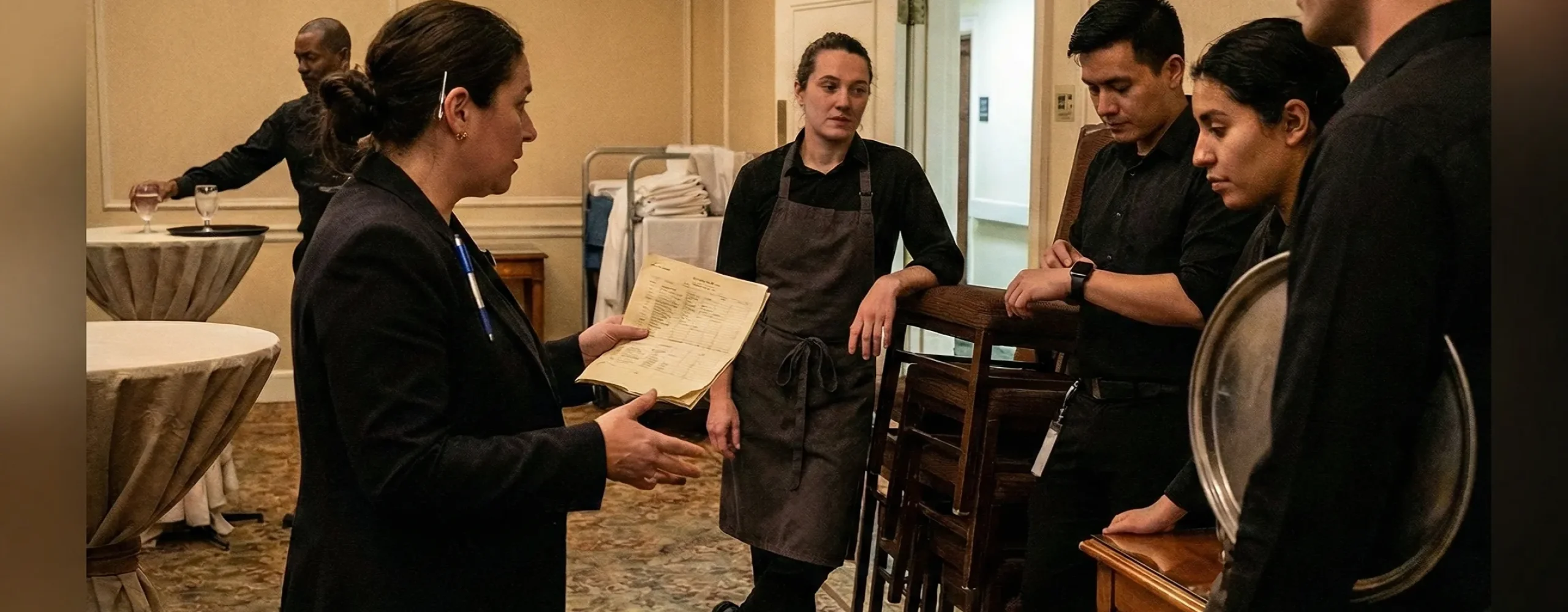
Availability Of Catering Staff In Chicago Vs Boston
Availability is one of the biggest operational differences between catering staff for hire in Chicago and Boston. The size of the labor market, seasonality, and union dynamics all influence how easily you can build a reliable team.
Chicago: Larger Labor Pool, More Flexibility
Chicago has one of the largest hospitality workforces in the Midwest. Major venues like McCormick Place regularly host high-capacity conventions, which sustains a deep bench of experienced servers, bartenders, chefs, and event crew.
What this means for planners:
- Easier to scale teams for 300–1,000+ guest events
- Better last-minute replacement availability
- Access to both union and non-union staff
- More competitive catering staffing rates due to volume
However, peak seasons, especially summer weddings and large expos, still require early booking for premium talent.
Use Case Example: A tech expo with 800 guests may need 40+ service staff. In Chicago, agencies can often assemble that within weeks. In Boston, that same request may require 6–8 weeks’ lead time.
Boston: Smaller Labor Pool, High Seasonal Demand
Boston’s hospitality market is strong but smaller. Staffing demand spikes during the spring wedding season, fall academic events (Harvard, MIT, etc.), biotech and finance conferences, and tourism-heavy summer weekends.
During these periods, securing catering staff in Boston becomes highly competitive. Additionally, some venues require specific certifications for food handling or alcohol service, which narrows the available pool further.
Operational Insight: Boston’s tighter market often results in higher staff retention, meaning teams may be more consistent and experienced with specific venues.
The macro picture reinforces this pressure. According to a February 2025 survey by the American Hotel & Lodging Association (AHLA) and Hierology, nearly two-thirds of hotels (65%) continue to report staffing shortages, with more than 71% saying they had job openings they were unable to fill despite active searches. AHLA For event planners in tight markets like Boston, this underscores why early agency relationships matter.
Union Vs Non-Union Trends
Chicago: Strong union presence in major hotels and convention venues, with non-union staffing agencies widely available for private events.
Boston: Union influence present in large venues, with more common reliance on agency-based professional staffing.
For planners, this affects minimum shift lengths, overtime thresholds, and staffing minimums per event.
Subscribe To Our NewsLetter
We help you to elevate your events with our highly skilled professionals. You got these three simple steps to book our service
Typical Roles And Responsibilities
While core catering positions remain consistent across cities, how those roles are structured and how many of each you’ll need differ between Chicago and Boston.
Understanding these differences helps you accurately plan when you hire catering staff in Chicago or build a Boston catering team structure.
Core Catering Roles In Both Cities
Most events in Chicago and Boston rely on the following standard positions:
- Event Captain / Floor Manager – Oversees service flow, coordinates with planners
- Servers – Tray-passed service, plated meals, buffet management
- Bartenders – Full bar, wine service, specialty cocktails
- Chefs / Culinary Staff – On-site food prep, carving stations
- Kitchen Assistants / Utility Staff – Prep, restocking, sanitation
- Setup & Breakdown Crew – Tables, rentals, staging support
Deployment, however, varies by city.
Chicago: Efficiency And Volume-Oriented Structure
Chicago events particularly at large venues like Navy Pier often emphasize scale and speed.
Common characteristics:
- Leaner server-to-guest ratios for large corporate events
- Cross-trained staff (servers doubling as buffet attendants)
- Larger bartender teams for high-volume events
- Clear separation between culinary and service teams
Example: At a 600-guest corporate gala, Chicago planners may operate with 1 captain, 1 server per 25–30 guests, and 1 bartender per 75 guests. The focus: throughput and efficiency.
Boston: Structured And Service-Focused Model
Boston events especially corporate and university-affiliated gatherings often lean toward a more segmented staffing approach.
Events at venues like Boston Convention and Exhibition Center typically reflect:
- Slightly higher server-to-guest ratios
- Dedicated cocktail servers during receptions
- Strict role delineation (fewer cross-functional tasks)
- Strong emphasis on polished presentation
Example: At a 400-guest biotech conference reception, Boston catering roles may include 1 captain, 1 server per 20–25 guests, dedicated cocktail servers separate from dining staff, and certified bartenders only. The focus: refined service flow and guest interaction.
Role Expectations Differ Subtly
Factor | Chicago | Boston |
Service Style | Fast-paced, scalable | Structured, presentation-focused |
Cross-Training | Common | Less common |
Cocktail Servers | Standard | Often, more dedicated staff |
Certification Emphasis | Moderate | Higher in many venues |
Choosing the right staffing structure isn’t about which city is “better,” it’s about matching the city’s service culture to your event goals.

Staffing Rates And Costs
One of the most practical differences between catering staff for hire in Chicago and Boston comes down to pricing. While both cities are premium event markets, labor dynamics and demand cycles create noticeable cost variations.
According to U.S. Bureau of Labor Statistics data, average hourly earnings in the leisure and hospitality industry rose from $16.84 in January 2020 to $22.53 in January 2025, outpacing inflation by about 8.6%. Escoffier global. This national trend is reflected and amplified in major event markets like Chicago and Boston.
Baseline Hourly Rates: Chicago Vs Boston
Role | Chicago (Avg Hourly) | Boston (Avg Hourly) |
Event Captain | $30–$40 | $35–$45 |
Server | $22–$30 | $25–$35 |
Bartender | $25–$35 | $30–$40 |
Chef / Culinary Lead | $35–$50 | $40–$55 |
Setup / Utility Crew | $20–$28 | $22–$32 |
Insight: Boston typically trends 10–20% higher than Chicago for comparable roles, especially during peak seasons.
Why Boston Often Costs More
Several factors influence higher catering staffing rates in Boston: a smaller labor pool that creates pricing pressure, predictable seasonal spikes tied to academic calendars, biotech conferences, and wedding season, certification requirements that narrow the available candidate pool, and venue protocols at large properties like Hynes Convention Center that may require specific staffing minimums or union rules.
Chicago’s Cost Advantages
Chicago benefits from a larger hospitality workforce, a greater union and non-union mix, high event volume at venues like The Geraghty, and a competitive agency landscape. Because the market is deeper, planners who hire catering staff in Chicago often have more negotiation flexibility, particularly for multi-day events.
Hidden Cost Factors To Consider
Rates alone don’t tell the full story. Consider minimum shift lengths (often 4–5 hours in both cities), overtime rules (state-specific thresholds), travel fees within metro areas, gratuity structures, and union venue surcharges.
Example: A 300-guest corporate dinner may cost similarly on paper in both cities, but in Boston, higher server ratios and stricter staffing minimums can increase total labor cost by 15–25%.
Budget Planning Tip
If staffing makes up 30–40% of your catering budget, Chicago offers slightly more pricing flexibility for large-scale events, while Boston requires earlier budgeting precision and stronger vendor coordination. Understanding these cost dynamics helps you avoid underestimating labor, one of the most common event planning mistakes.
Hiring Tips For Chicago Vs Boston
Even experienced planners adjust their staffing strategy depending on the city. While both markets are professional and competitive, the approach to booking and structuring teams differs significantly. For a broader view of agency selection across major markets, our post on how to find the best conference staffing agencies in the US provides a useful framework.
Chicago: When And How To Book
Chicago’s larger labor market gives planners flexibility but that doesn’t mean you can wait until the last minute for premium talent.
Best Practices:
- Book 4–6 weeks in advance for weddings and corporate galas
- Book 8+ weeks ahead for summer weekends or major convention overlap
- Confirm whether your venue requires union labor
- Ask agencies about cross-trained staff to optimize ratios
Recommended Staff-To-Guest Ratios In Chicago:
- Plated dinner: 1 server per 25–30 guests
- Buffet: 1 server per 30–35 guests
- Bartenders: 1 per 75–100 guests
- Event captain: 1 per event
Because of the competitive agency landscape, Chicago planners can often negotiate bundled staffing for multi-day conferences.
Boston: Plan Earlier And Expect Structure
Boston’s tighter labor pool and higher certification requirements mean early planning is critical.
Boston Booking Tips:
- Book 6–8 weeks ahead for standard events
- Secure staff 10–12 weeks early during peak academic or wedding seasons
- Confirm alcohol service certification requirements
- Clarify venue staffing minimums before finalizing headcount
Boston venues particularly near academic institutions and downtown convention districts often expect formal service structure. Volunteer or casual staffing is rarely acceptable for corporate-level events.
Agency Selection Matters More In Boston
In Chicago, the size of the market allows flexibility between agencies. In Boston, choosing the right staffing partner early reduces risk. Look for agencies that have venue-specific experience, maintain certified bartenders, and provide consistent team leads familiar with local compliance rules.
Pro Tip For Multi-City Event Planners
If you’re planning events in both cities, use Chicago’s flexibility to scale efficiently, treat Boston as a precision market requiring structured early commitments, and adjust your timeline, budget buffer, and headcount strategy accordingly.
Event Types And Staffing Considerations
The type of event you’re planning significantly influences how you approach catering staff for hire in Chicago versus staffing in Boston. Each city’s event culture shapes expectations, staffing ratios, and logistical coordination.
Weddings
- Chicago Weddings: Larger guest counts are common (250–500 guests). Venues like The Drake Hotel often accommodate high-capacity receptions with leaner staffing ratios for plated dinners and faster-paced bar service expectations.
- Boston Weddings: Slightly smaller average guest sizes, more formal dining flow, higher server-to-guest ratios, and greater emphasis on synchronized plated service.
- Insight: Boston wedding staffing tends to prioritize presentation and pacing, while Chicago weddings often prioritize efficiency at scale.
Corporate Events And Conferences
- Chicago: Major trade shows at McCormick Place drive demand for large-volume staffing, high-speed service, flexible team scaling, and extended shift coverage. Corporate events frequently require 1 bartender per 75–100 guests and lean service teams with cross-functional staff.
- Boston: Events near Boston Convention and Exhibition Center often require structured service roles, dedicated cocktail servers, certified bartenders, and strict adherence to venue staffing minimums. Boston corporate events may involve more layered team structures, particularly in biotech and finance sectors where hospitality reflects brand perception.
For planners managing multi-day conferences in either city, our guide on how to hire event team leads in 2026 walks through the operational planning that keeps large-scale service running smoothly.
University And Academic Events (Boston-Specific Impact)
Boston’s concentration of academic institutions increases demand for formal seated dinners, faculty receptions, alumni galas, and graduation banquets, events that require tight service choreography, professional presentation standards, and higher staffing ratios. Chicago has academic events as well, but Boston’s density amplifies seasonal staffing pressure.
Festivals And Outdoor Events
- Chicago: Larger public festivals with high-volume food and beverage flow, more casual staffing models, and greater reliance on utility crew and setup teams.
- Boston: More regulated event permitting, tighter staffing compliance, and smaller footprint events requiring structured oversight.
Logistics And Venue Layout Differences
Chicago venues often accommodate large guest movement and exhibit-style layouts. Boston venues, particularly older or historic properties, may present narrower service corridors, multiple floors, restricted loading zones, and tight setup windows. These logistical constraints can increase staffing needs in Boston due to additional setup crew, more runners, and longer breakdown timelines.
The same principles apply when staffing large outdoor activations. Our post on event runner staffing for large-scale shows covers the logistics side in detail.
Key Planning Insight
If your event is high-volume and scalable, Chicago offers flexibility and speed. If it’s detail-driven and structured, Boston requires precision and higher service layering. Matching your staffing approach to the city’s event culture ensures smoother execution, better guest flow, and fewer operational surprises.
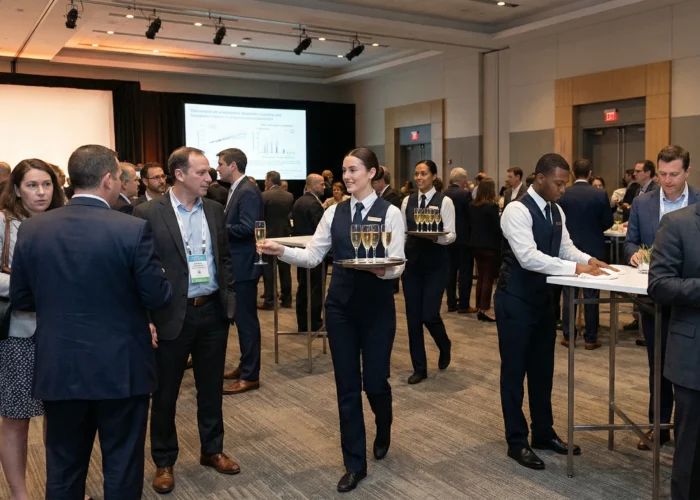
FAQs
How Far In Advance Should I Hire Catering Staff In Chicago Or Boston?
For catering staff for hire in Chicago, booking 4–6 weeks in advance is typically sufficient for standard events. During peak summer wedding season or major conventions at McCormick Place, plan for 8+ weeks.
For catering staff in Boston, timelines are tighter. Book 6–8 weeks ahead for most events and 10–12 weeks in advance during peak academic, conference, or wedding seasons, especially near venues like the Boston Convention and Exhibition Center.
Are Catering Staffing Rates Negotiable Between Cities?
Rates can be negotiable in both cities, but flexibility differs. Chicago’s larger labor pool allows more room for negotiation, particularly for multi-day events or large headcounts. Boston has less flexibility during peak seasons due to tighter labor availability. Negotiation is more likely when booking early, securing staff for multiple days, or working with a preferred agency partner. Explore Premier Staff’s catering staff services nationwide to get a quote that reflects the local market.
Can Catering Staff Be Shared Between Multiple Venues?
Generally, no, especially for larger events. Most agencies schedule staff per event block and per venue. Travel time between venues may trigger additional hourly minimums, overtime pay, or separate shift requirements. In Boston, strict venue policies often make staff-sharing impractical. In Chicago, limited cross-venue use may be possible if logistics allow and agencies approve.
For events that require multi-location coordination, working with an experienced hospitality staffing team makes scheduling far easier.
Do Local Certifications Matter?
What Is The Ideal Staff-To-Guest Ratio?
While it varies by event type, general benchmarks differ between the two cities.
Chicago Typical Ratios:
- Plated dinner: 1 server per 25–30 guests
- Buffet: 1 per 30–35 guests
- Bartender: 1 per 75–100 guests
Boston Typical Ratios:
- Plated dinner: 1 server per 20–25 guests
- Cocktail reception: Higher ratio of dedicated cocktail servers
- Bartender: 1 per 60–75 guests
Boston’s ratios tend to be slightly more service-intensive. For help calculating the right headcount for your specific event size and format, Premier Staff’s event staffing services can provide a customized breakdown based on your guest count, format, and timeline.
Conclusion
Understanding the difference between catering staff for hire Chicago and Boston staffing models gives planners a measurable operational advantage.
Chicago rewards scale, flexibility, and cost efficiency. Boston rewards precision, early booking, and structured service design.
The most successful planners don’t treat these cities the same. They adjust staffing ratios, certification planning, booking timelines, and labor budgeting to match each market’s realities.
If you’re planning an event in Chicago or Boston and want a market-specific staffing strategy, request a customized staffing cost review today. Our team will break down headcount recommendations, certification requirements, and projected labor ranges based on your guest count, venue, and service format.
Smart staffing isn’t just about filling roles. It’s about protecting guest experience, compliance, and brand reputation city by city.
Are You Ready to Elevate Your Event?
Don’t wait—book Premier Staff now to secure top-tier professionals for your next event.
Recommended Posts

An event brand ambassador is the person who represents your brand to guests from setup to wrap-up. Before your event,...