
- In-Store Marketing Strategy: How Retail Staff Turn Shopper Hesitation into Sales
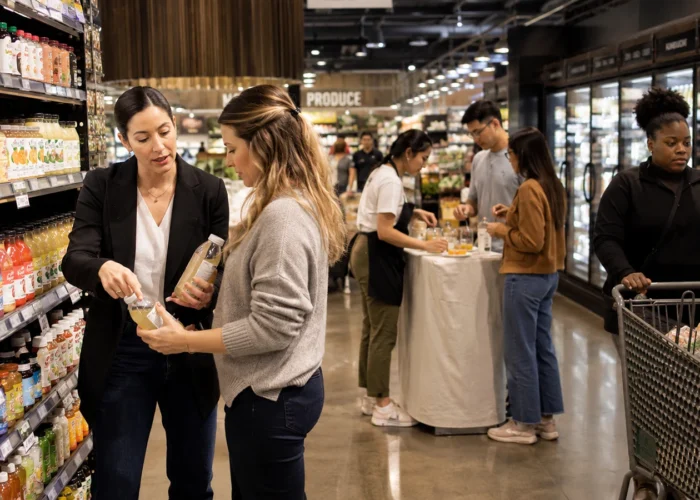
In-Store Marketing Strategy: How Retail Staff Turn Shopper Hesitation Into Sales
A shopper picks up your product, checks the price, and hesitates.
That moment decides whether you win the sale or lose it to the competitor next to you.
In-store marketing is not just about displays or promotions. It’s about what happens in the few seconds when a shopper compares, questions, and decides.
In this guide, you’ll learn how trained retail staff, product demonstrations, and smart retail activation strategies turn hesitation into conversion and how to build an in-store marketing strategy that actually drives sales.
Executive Summary
This blog explains how in-store marketing works at the exact point where shoppers pause, compare, and decide what goes into the cart. It covers why shelf hesitation matters, how trained retail staff answer buyer doubts, which staff roles fit different product categories, how sampling and demos should connect back to purchase, why briefing affects conversion, and when brands should use outside staffing support instead of trying to manage every retail activation in-house.
The mistake I see in retail activations is that brands plan around the store count before they plan around the shopper’s hesitation. A product demo should start with the question the shopper is already asking in their head. That is where the staff brief has to begin.
— Daniel Meursing, CEO of Premier Staff
Shoppers make most buying decisions inside the store, often within seconds of comparing products on the shelf.
- Over 70% of purchase decisions happen in-store
- Most shoppers spend under 7 seconds comparing products
- Live demos and sampling can increase conversion by 20–40%
- Human interaction builds trust faster in categories like beauty, food, and tech
What this means:
If your product needs explanation, comparison, or reassurance, shelf visibility alone will not convert the sale.
Why Is In-Store Marketing Strategy Important for Retail Sales?
In-store marketing matters because most buying decisions happen inside the store, not before.
Shoppers arrive with options, but they decide based on:
- What they see on the shelf
- What they understand about the product
- And whether someone answers their hesitation
Without staff support, even strong products lose at the final step.
Why the Point of Purchase Moment Defines In-Store Marketing Strategy Success
In-store marketing starts at the moment a shopper almost buys. They pick up the product, check the price, scan the label, look at the competitor, and pause. If no one answers the doubt forming in that moment, the product often goes back on the shelf.
A trained retail staffer can change that pause into a decision. For a premium protein drink, the question may not be “Do you want to try this?” It may be “Are you using it after workouts or as a meal replacement?” That small shift moves the conversation away from price and toward fit.
The point of purchase is the retail moment where the shopper is closest to buying, which makes staff quality a direct part of the conversion path. Investopedia defines point of purchase as the time and place where a retail transaction occurs.
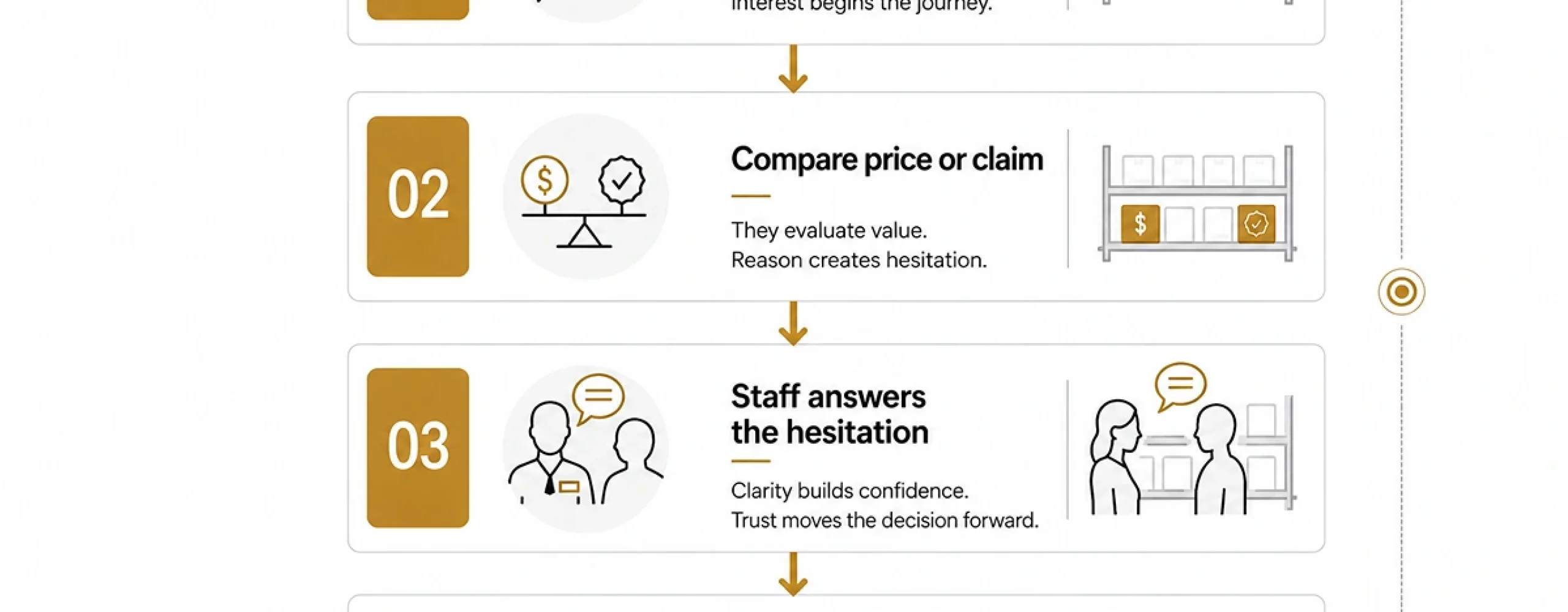
Pick up product
↓
Compare price or claim
↓
Staff answers the hesitation
↓
Product moves toward cart
For brands planning retail activation ideas, the staffing plan should start with the shopper’s hesitation, not only the store count.
Most Retail Campaigns Lose People in the Five-Second Comparison
In-store marketing fails fastest when staff only repeat what the package already says. Shoppers compare quickly: price, size, ingredient, claim, habit, shelf position, and whatever they already know about the competitor.
A beauty aisle makes this obvious. A shopper comparing two serums may not ask a clean question. They may pick one up, read the back, look at the other, and hesitate. A weak response sounds like, “This one is popular.” A better staff move is, “If your skin gets irritated under makeup, this one is the safer match.”
Walmart’s move to add trained beauty advisers in selected stores shows how much value retailers still place on human guidance in high-comparison categories like skincare and makeup. AP reported that Walmart plans to expand the adviser model to hundreds of U.S. stores by the end of 2026.
Shopper Signal | Weak Response | Better Staff Move |
Checks price twice | “It’s on sale.” | Explains value by use case |
Reads ingredients | “It’s clean.” | Explains the claim clearly |
Looks at competitor | “Ours is better.” | Names the practical difference |
For PremierStaff, this is where brand ambassadors have to act like retail readers, not walking scripts.
Subscribe To Our NewsLetter
We help you to elevate your events with our highly skilled professionals. You got these three simple steps to book our service
Product Demonstrators Should Diagnose Before They Pitch
A good retail marketing strategy does not ask product demonstrators to launch into features the moment someone stops. The first move should be diagnosis. Why did the shopper stop? Price? Confusion? Curiosity? A comparison with something already in their cart?
A smart home device demo makes this clear. The shopper may not care about every feature. They may want to know if it works with their current phone, how difficult setup is, and whether it solves a daily problem. Apple’s retail model gives shoppers the option to browse, shop, and demo products in one-to-one sessions with a Specialist, which shows how much product categories with explanation still rely on guided interaction.
Mistake to avoid: starting with the product’s strongest feature. Start with the shopper’s reason for stopping, then show the feature that fits.
For product-heavy retail campaigns, PremierStaff’s brand ambassadors should be briefed to ask better first questions, not just repeat product copy.
Sampling Staff Can Create Trial or Block the Aisle
Some marketing strategies for retail stores treat sampling like a volume game: give away as much product as possible and hope shoppers remember it later. In a busy grocery aisle, that can backfire. A slow table blocks traffic. A rushed staffer gives out samples with no product story. A shopper tastes the item and walks away without knowing where to buy it.
A snack brand sampling at Whole Foods should connect the sample back to the shelf. Staff should know the product location, one clean claim, current promo, common dietary question, and what to say when the shopper likes it. Whole Foods’ LEAP program shows how emerging food brands may move toward store placement after mentorship and review, which makes retail readiness a serious step for growing CPG brands.
Sampling checklist:
- Where is the product shelved?
- What is the one-line claim?
- Is there a promo or QR offer?
- Who keeps the aisle clear?
- How will staff track shopper reactions?
For brands planning retail activation ideas, sampling should point shoppers toward purchase, not just trial.
Why This Matters for Your Retail Campaign
If your staff cannot answer the shopper’s hesitation in real time, your marketing investment stops at awareness.
Retail performance depends on:
- Staff training quality
- Real-time product explanation
- Timing of shopper interaction
Without these, even high-footfall stores fail to convert attention into sales.
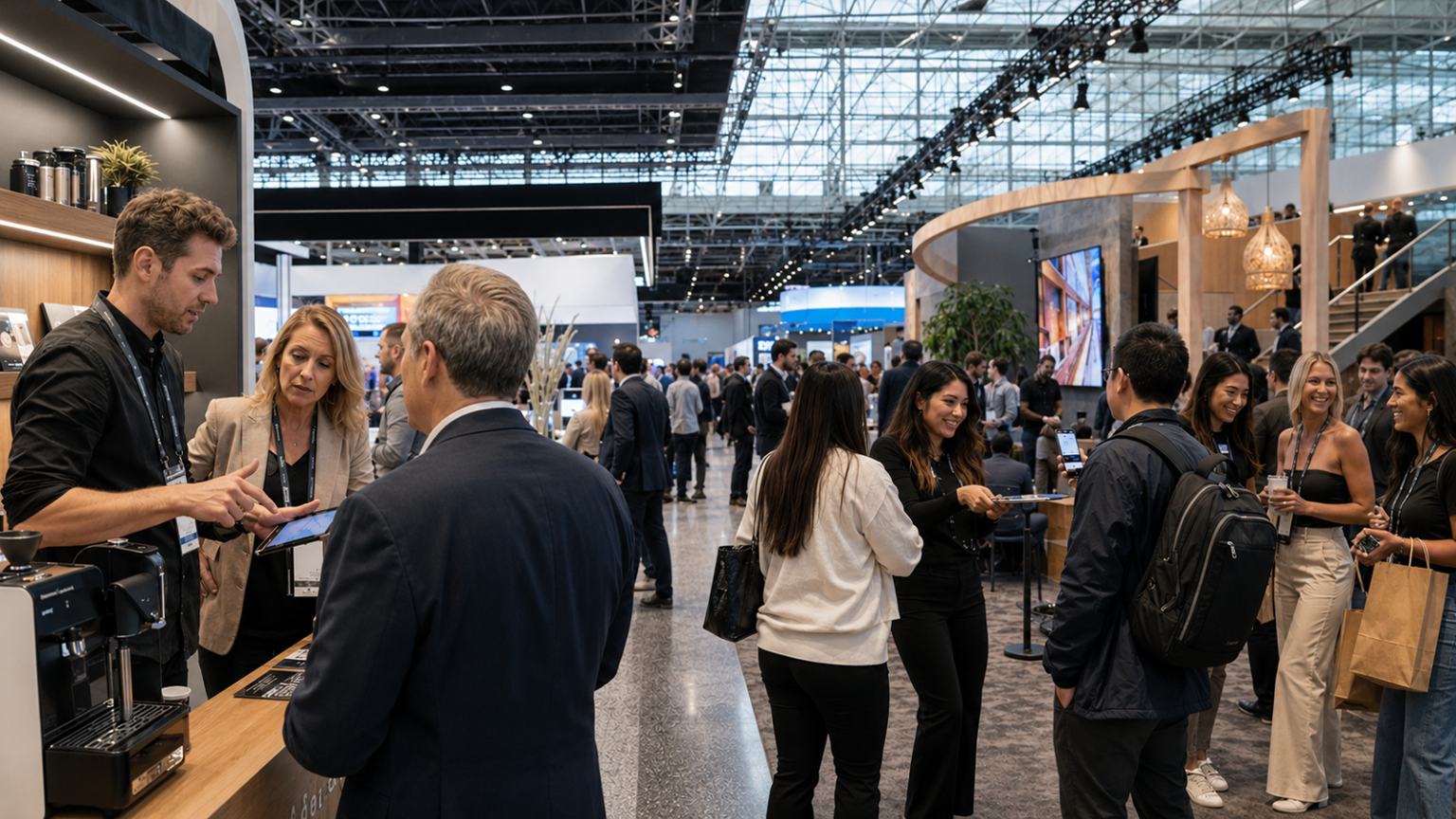
The Wrong Staff Role Makes the Retail Plan Look Weak
A retail marketing strategy can look solid on paper and still fall apart in the aisle if the staff role is wrong. Sampling staff, product demonstrators, beauty educators, and specialist retail staff do different jobs. Swapping one for another usually shows up in awkward conversations, missed questions, or slow traffic.
A premium haircare launch inside Ulta is a good example. A shopper may ask about hair texture, usage order, ingredient concerns, salon use, or results. That requires product fluency, not only a friendly table presence. Cécred’s Ulta launch included availability in 1,400+ stores and training for 7,000 Ulta stylists to use and recommend the products, showing how much category knowledge matters in beauty retail.
Campaign Type | Staff Role |
Snack sample | Sampling staff |
Beauty launch | Product educator |
Tech demo | Product demonstrator |
Alcohol tasting | Specialist retail staff |
Multi-store rollout | On-site coordinator |
.
A Retail Brief Should Teach Staff the Question Shoppers Won’t Ask
In-store staff training should prepare staff for the question a shopper is circling around but may not say directly. Price, ingredients, usage, competitor comparison, taste, texture, safety, or value often sit under a casual line like, “I usually buy the other one.”
A premium supplement demo shows the problem clearly. The shopper may not ask, “Why does this cost more?” Staff should be ready to explain serving size, ingredient difference, use case, and who the product is best for without sounding defensive.
A useful in-store brief should cover:
- The shopper’s likely hesitation
Price, ingredients, use case, comparison, taste, texture, or value. - The plain-language answer
Staff should be able to explain the product without sounding scripted. - The claim boundary
Staff should know what they can say, what they cannot promise, and when to avoid over-explaining. - The next action
Shelf direction, sample, QR scan, promo, coupon, or handoff.
A weak brief gives staff a script. A useful retail brief gives them buyer signals to watch for, language they can use naturally, and claims they should avoid. If the product has compliance concerns, the brief also needs clear boundaries before staff reach the floor.
For brands preparing a retail rollout, use PremierStaff’s contact page to plan the staffing brief before the store dates are locked.
Costs Look Different When You Budget for Conversion, Not Coverage
In-store marketing campaign costs in 2026 should not be judged by staff day rate alone. A snack sample, beauty consultation, tech demo, and alcohol tasting do not ask the staff to do the same job.
A 10-store beauty rollout may cost more per person than a snack sampling program because the team has to answer usage questions, read shopper hesitation, explain shade or product fit, and report what people asked before buying. A general sampling role can move fast. A product educator has to slow the moment down without blocking the aisle.
For regulated categories, cost also changes because the staff may need stricter briefing or specialist knowledge. TTB’s retail dealer guidance explains that federal liquor laws and regulations affect retail alcohol dealers, which is why alcohol tastings cannot be staffed like regular samples.
Cost Driver | Low Complexity | High Complexity |
Product | Snack sample | Beauty, alcohol, tech |
Role | Sampling staff | Product educator |
Briefing | Shelf and offer | Objections and compliance |
Reporting | Samples given | Questions and purchase signals |
For brands trying to price the field team properly, it is safer to talk through the staffing plan before locking the rollout.
How Better Staffing Increased Retail Conversion (Example)
A premium beauty brand running in-store demos saw low conversion despite high foot traffic.
After adjusting their staffing strategy:
- Staff were trained to diagnose shopper needs first
- Product explanations were simplified into use cases
- Sampling was tied directly to shelf placement
Result:
- Higher engagement per interaction
- More confident purchase decisions
- Noticeable lift in conversion at the shelf level
Common In-Store Marketing Strategy Mistakes That Kill Conversion
Many retail campaigns fail for predictable reasons:
- Staff repeat packaging instead of adding value
- Sampling happens without directing to shelf
- Wrong staff role for product complexity
- No preparation for shopper objections
- Weak or overly scripted retail briefs
Fixing these issues often improves conversion faster than increasing store count.
In-House Works When the Brand Has Repetition, Not Just Enthusiasm
Knowing how to run an in-store marketing activation once is different from running it across stores, cities, teams, and category rules. In-house can work when the product is simple, the market is local, and the activation repeats often enough for the team to build a playbook.
A beverage startup running four local grocery demos may manage the program internally. A premium beverage brand rolling out 60 tastings across New York, Miami, Austin, and Los Angeles needs store coordination, shift notes, staff replacement plans, compliance checks, and consistent reporting.
Whole Foods’ 2026 LEAP program shows how emerging brands can move toward retail readiness through mentorship, education, and possible local or regional store placement after completion.
Use in-house when:
- the activation repeats often
- the product is simple to explain
- the same team can be trained repeatedly
- compliance risk is low
- reporting is already built
Use outside staff when:
- the product is new or premium
- the rollout spans multiple stores or cities
- the product needs explanation
- specialist staff are required
- the brand needs cleaner shift notes and replacement coverage
If the product depends on shelf-level explanation, build the staffing plan around the shopper’s hesitation, not only the store count.
If your product needs more than shelf space to win the buyer, build the staffing plan around the moment shoppers pause, compare, and decide.
FAQs
What is in-store marketing and how does it work?
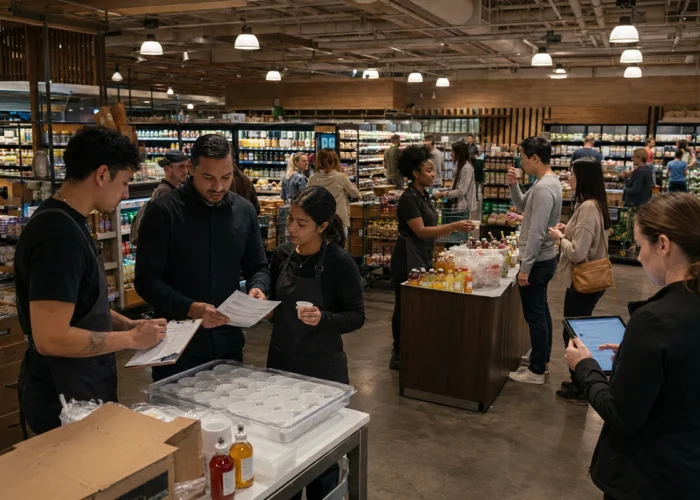
In-store marketing is retail promotion that happens inside the store, close to the moment of purchase. It can include product demonstrations, sampling, shelf-level brand ambassador support, retail displays, QR offers, and staff-led product education. For brands planning store-level campaigns, PremierStaff’s retail activation ideas show how live retail moments can be structured around shopper action.
What staff roles does an in-store marketing campaign need?
Most campaigns use a mix of sampling staff, product demonstrators, brand ambassadors, specialist retail staff, and sometimes an on-site coordinator. The role mix depends on the product. A snack sample may need speed and shelf direction. A beauty, supplement, alcohol, or tech product may require staff who can answer deeper questions before the shopper buys.
What is the difference between sampling staff and product demonstrators?
Sampling staff create fast trials. They hand out product, keep traffic moving, explain one clear claim, and point shoppers toward a shelf or offer. Product demonstrators spend more time with the shopper: explaining features, answering objections, and guiding the buying decision. For retail campaigns that need trained guest interaction, PremierStaff’s brand ambassadors can be briefed around the product and shopper moment.
How much does in-store marketing staffing cost?
In-store staffing cost depends on city, store count, shift length, product category, staff role, briefing depth, and compliance requirements. General sampling staff usually cost less than product educators or specialist retail staff. A better estimate starts with the buying moment: what must the staff explain, manage, or protect at shelf level? Use PremierStaff’s contact page to price the staffing plan around the actual rollout.
Plan Your In-Store Marketing Strategy Rollout With Trained Retail Staff
If your product needs explanation, comparison, or trial to convert, your staffing strategy matters more than your display.
Work with PremierStaff to:
- Match the right staff role to your product category
- Build conversion-focused retail briefs
- Execute multi-store activations without gaps
👉 Start planning your retail activation today
Are You Ready to Elevate Your Event?
Don’t wait—book Premier Staff now to secure top-tier professionals for your next event.
Recommended Posts
An event brand ambassador is the person who represents your brand to guests from setup to wrap-up. Before your event,...