
- How to Hire a Logistics Staffing Agency in the US

Effective logistics staffing is the backbone of any large-scale event. It is not about simply adding more hands; it is about creating a structured traffic control system that manages people, inventory, and equipment seamlessly from load-in to load-out. Without a clear plan, small disruptions such as dock congestion, misrouted cases, or untracked inventory can quickly escalate, pulling your team into problem-solving instead of running the event.
This guide explains how to hire a logistics staffing agency that provides scalable supervision, precise routing, and operational control at large venues. You will learn how proper staffing protects timelines, reduces overtime, and ensures a smooth back-of-house operation while allowing front-of-house teams to focus on guest experience.
Executive Summary
To hire a logistics staffing agency for large US venues, prioritize providers who offer scalable supervision structures and written flow plans rather than just headcount. This approach mitigates dock congestion and inventory loss while protecting your budget from overtime spikes.
Most people hire logistics staff thinking they need 'extra hands.' I tell them they actually need a traffic control system. Whether it’s staggering load-ins or managing elevator flows, the value isn’t in the lifting, it’s in the sequencing. At Premier Staff, we provide the architectural oversight that ensures the chaos of load-in never reaches the guest experience.
— Daniel Meursing, CEO of Premier Staff
What Logistics Staffing Covers at Large Venues
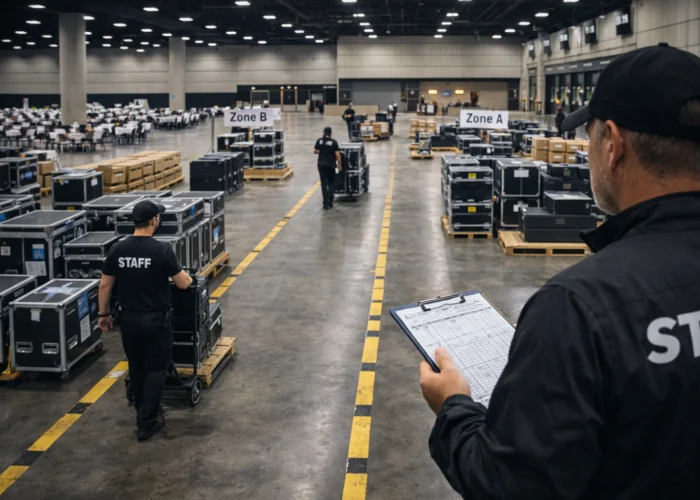
At large venues, logistics staffing is essentially traffic control for people, equipment, and inventory. A well-executed logistics staffing plan ensures that trucks, pallets, vendors, and runners move efficiently without disrupting the event flow. When done correctly, logistics staffing feels seamless. Everything moves, nothing piles up, and radios remain quiet.
A comprehensive logistics staffing agency typically provides:
- Dock Management: Scheduling arrivals, managing bay turnover, and coordinating vendor arrivals.
- Staging Lanes: Organizing inventory before it moves to the event floor.
- Runner Routes: Pre-mapped paths to avoid guest crossover and maximize efficiency.
- Inventory Logs: Tracking handoffs between zones to prevent missing items.
- Radio Protocol: Defined channels for rapid escalation and communication.
- Escalation Ladder: Clear lines of authority to solve problems before they reach the client.
Use Case: At a recent national trade show, a logistics staffing agency implemented pre-mapped runner routes and dock schedules. Over 2,500 pieces of equipment moved without delays, preventing what could have been a 45-minute stall during load-in.
When load-in starts clean, the event runs smoothly. Without structured logistics staffing, even minor disruptions such as a sponsor arriving early or AV equipment delayed can cascade into major operational headaches.
See how we handled similar complex logistics in our staffing case studies for major brands.
Logistics Staffing vs General Event Staffing
Understanding the difference between logistics staffing and general event staffing is critical for large events. Logistics staffing focuses on back-of-house operations, ensuring people, equipment, and inventory move efficiently. General event staffing focuses on front-of-house tasks that directly support guest experience.
Category | Logistics Staffing | General Event Staffing |
Primary goal | Maintain flow, timing, and inventory control | Support guest-facing service |
Typical tasks | Dock coordination, staging lanes, runner routes | Check-in, ushering, registration |
Supervision required | High: BOH lead + zone supervisors | Moderate: task leads |
Tools & systems | Runner routes, dock schedules, handoff logs | Checklists, scripts |
What fails first | Dock congestion leading to staging crush and missing inventory | Long lines, slow resets |
The key takeaway is that adding more hands does not solve operational bottlenecks. A logistics staffing agency provides the structure and supervision needed to maintain flow, prevent errors, and protect timelines.
Example: At a multi-day corporate conference in Chicago, deploying a logistics staffing agency with clear dock coordination and runner routes reduced missing inventory incidents by 90 percent compared to relying on general event staffing alone.
When to Hire a Logistics Staffing Agency
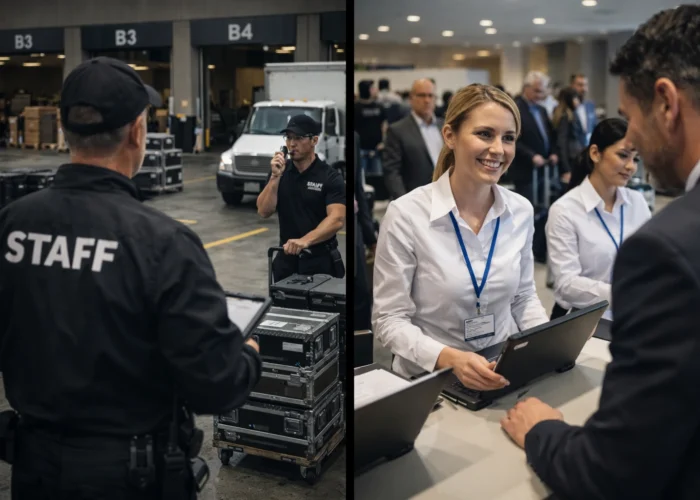
Knowing when to hire a logistics staffing agency is essential to avoid operational breakdowns. Internal teams have limits, and coordination tasks can quickly overwhelm staff if load-in windows, vendor density, or venue restrictions are complex.
Use the following guideline to determine when external logistics staffing support is needed:
Key Triggers
- 500+ guests: Coordination load spikes, and front-of-house teams get pulled into back-of-house tasks.
- 6+ vendors: Arrival collisions can cause dock congestion.
- Multi-zone footprint: Runner overlap leads to missed replenishments.
- Union or venue restrictions: Limited access can cause delays and rework.
- Tight load-in/load-out windows: Increases risk of overtime and late doors.
- Large inventory movement: High handoff volume increases the chance of missing items.
- Early or overnight calls: Staff gaps can delay critical setup tasks.
If three or more of these triggers apply, it is time to hire a logistics staffing agency to maintain operational control.
Use Case: At a trade expo in New York, internal staff were struggling to manage six vendors across multiple zones. Bringing in a logistics staffing agency with pre-defined runner routes and a dock schedule prevented gridlock and allowed the event to open on time.
A simple rule works well in practice: if you hit three or more of the triggers below, hire a logistics staffing agency. For budgeting help, review the average cost to hire staffing support.
“3+ Triggers = Hire an Agency” Checklist
Trigger | Why it matters | If ignored, what breaks next? |
500+ guests | Coordination load spikes | FOH pulled into BOH fires |
6+ vendors | Arrival collisions | Dock congestion |
Multi-zone footprint | Runner overlap | Missed replenishment |
Union / venue restrictions | Limited access | Delays and rework |
Tight load-in/load-out | No recovery window | OT and late doors |
Large inventory movement | High handoff volume | Missing items |
Limited dock access | Throughput bottleneck | Staging backups |
Early/overnight calls | Show-up risk | Coverage gaps |
Hard venue cutoff | No flexibility | Unsafe shortcuts |
Once you know you need help, the question isn’t who is cheapest. It is who shows up with a plan.
Identifying the need for agency support is only the first step; the bigger challenge is navigating a US labor market where availability and rates fluctuate wildly by region.
Subscribe To Our NewsLetter
We help you to elevate your events with our highly skilled professionals. You got these three simple steps to book our service
How to Hire a Logistics Staffing Agency in the US
Teams don’t get burned because they hired a logistics staffing agency too early. They get burned because they hired one too vaguely.
Headcount doesn’t equal control. A crew can be “fully staffed” and still collapse if nobody is supervising, routing, or tracking handoffs. And if the agency’s plan is basically “we’ll send people,” then you are still the plan.
This matters even more now because labor costs keep rising. The Employment Cost Index for private-industry wages continued increasing through 2025, which means overtime, rework, and poor planning are some of the fastest ways to blow a budget. Tight scopes and clear contracts aren’t paperwork; they are cost controls. To ensure nothing is missed, cross-reference your scope with this luxury planning checklist.
Geography also dictates your strategy. In union-heavy markets like Chicago (McCormick Place) or New York (Javits Center), logistics staff often cannot touch freight until it crosses specific threshold lines, requiring agencies to work hand-in-glove with Teamsters. In right-to-work states like Florida or Texas, flexibility is higher, but so is the competition for quality labor during peak convention seasons. A national agency will adjust its recruitment and compliance model based on these local realities, ensuring you don’t accidentally violate venue contracts.
Hiring Workflow for Logistics Staffing
Step | What you define | What the agency must provide |
Define scope | Zones, tasks, call times | Written scope of work |
Estimate headcount | Guests, vendors, inventory | Ratio-based staffing plan |
Choose model | Local vs nationwide | Backup strategy |
Vet experience | Venue + format history | References |
Validate supervision | Lead + span of control | Org chart |
Require a plan | Routes + timing | Day-of plan |
Confirm readiness | Dock + staging flow | Venue-aware routing |
Lock terms | OT + replacements | Written contingencies |
Your agency’s plan must include these four things before you sign:
- Roles by shift: Who is responsible for each task.
- Runner routes: Paths to move equipment efficiently.
- Dock schedule: Arrival times in 20-minute windows to prevent congestion.
- Escalation ladder: Who resolves issues before they affect the client.
Timing matters as much as staffing. Late bookings reduce options, increase costs, and often limit the ability to meet venue compliance requirements.
Use Case: For a multi-day corporate conference in Texas, early coordination with a logistics staffing agency allowed the team to pre-assign runner zones, schedule dock arrivals, and define escalation protocols. This prevented missed deliveries and reduced overtime by 30 percent.
When to Book Logistics Staffing
Lead time | Applies when | Risk if late |
2 weeks | Small markets | Thin crews |
3–4 weeks | Standard venues | Fewer backups |
5–6 weeks | Busy seasons | Higher costs |
8+ weeks | Union venues | Compliance gaps |
Before signing, you should have a one-page logistics plan. Roles by shift. Runner routes. Dock schedule. Escalation ladder. Nothing fancy, just real.
Roles You Should Expect
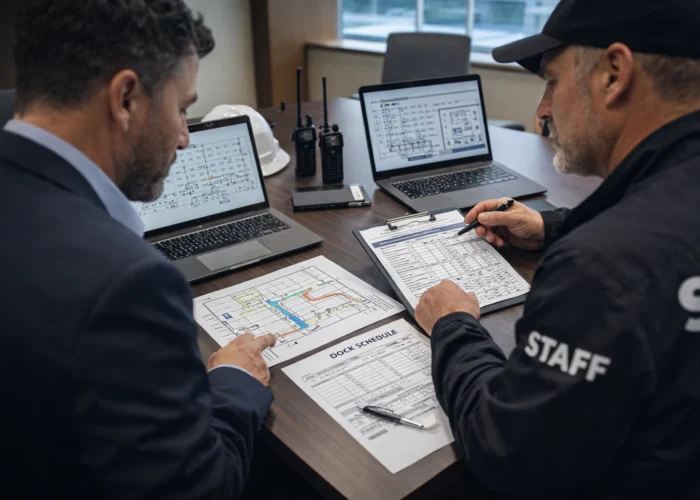
Some roles don’t look busy, but they prevent disasters. That is the uncomfortable truth of logistics: the best operators don’t look frantic.
Dock coordination and inventory control are the most underestimated. When they work, nothing happens. Trucks arrive on time. Cases move once. Nobody asks, “Has anyone seen that?” When they fail, everything downstream pays for it. A failed dock leads to staging congestion, which leads to FOH delays, which leads to angry stakeholders.
Outsourcing these roles is normal. But authority has to be clean. If an outsourced lead is expected to control the dock, they need permission to say no. Otherwise vendors push, decisions stall, and the dock collapses. This is similar to the strict roles required in sports staffing positions where every zone has a dedicated owner.
Logistics Staffing Roles for Large Venues
Role | What they handle | Why it matters |
Logistics Manager / BOH Lead | Overall flow + escalation | Prevents cascading failures |
Staging Supervisor | Staging lanes + sequencing | Prevents pileups |
Runners (by zone) | Physical movement | Keeps departments moving |
Dock Coordinator | Vendor arrivals | Prevents dock chaos |
Inventory Control | Tracking + sign-offs | Prevents loss |
AV Support | Setup support | Reduces tech delays |
Safety / Security | Compliance | Prevents stoppages |
Float / Relief | Spike coverage | Controls OT |
Operational Insight: Outsourced leads must have authority to make decisions. Without clear permission, vendor requests can stall operations, and the dock or staging area can collapse. This mirrors the strict zone ownership approach used in sports event staffing where every area has a dedicated owner.
Use Case: At a high-profile corporate gala in New York, clearly assigning a Dock Coordinator and Staging Supervisor prevented two trucks arriving simultaneously from causing a 40-minute delay during load-in.
Logistics Staffing Ratios That Hold Up
Ratios are a starting point, not a promise. Distance, zones, vendor overlap, and timing windows change everything.
A minimum plan prevents collapse. An optimal plan protects FOH and reduces OT. Always staff bottlenecks first. If dock and inventory control are thin, adding runners just adds noise; more movement, more miscommunication, more “where did it go?”
Logistics Staffing Ratios by Guest Count
Guests | Minimum Plan | Optimal Plan | Add 10-20% when… |
300–500 | 1 Lead, 1 Sup, 4–6 Runners | +1 Runner | Long distances |
500–750 | + Dock + Inventory | +2 Runners | Vendor overlap |
750–1,000 | +2 Sups | + Float | Freight elevators |
1,000–1,500 | +2 Inventory | + Dock | Multi-day |
1,500–3,000 | +3 Sups | +20% buffer | Activations |
Key Insight: Headcount alone does not guarantee control. The agency providing staff must have systems for training, deployment, and retention. Logistics staffing without operational oversight creates noise instead of efficiency.
Use Case: A logistics staffing agency handling a 1,200-guest trade show used these ratios and pre-mapped runner routes. The event maintained on-time load-in and zero lost inventory across three zones.
Vetting a Logistics Staffing Agency: Questions and Proof Points
Anyone can say they staff large events. Strong agencies explain how things fail and how they prevent it.
This matters because worker pressure hasn’t eased. Real average hourly earnings were flat in late 2025 according to BLS employment data, meaning tough shifts need clearer supervision and incentives to stay reliable. You don’t need to overthink it. You just need to plan for reality.
Ask for systems. Runner routes. Dock plans. Replacement policies. If they can’t show you those, you are guessing.
Key Questions to Ask
Category | Question | Proof / Documentation |
Experience | Have you staffed similar venues and formats in the last 12 months? | References or case studies |
Training | How are runners trained and supervised? | Training outline or materials |
Systems | Do you provide runner routes and dock plans? | Sample operational plan |
Reliability | What is your replacement policy within 2 hours? | Written contingency policy |
Compliance | Are you familiar with union rules and venue credential requirements? | Credential process documentation |
Communication | Who is the single on-site decision-maker? | Organizational chart showing lead authority |
Red Flags vs Green Flags
Topic | Red Flag | Green Flag | Operational Consequence |
Supervision | Assigned day-of | Named lead | No lead leads to indecision |
Planning | Headcount only | Written routes | No routes cause collisions |
Overtime | “We will see” | Defined thresholds | Unexpected budget spikes |
Dock | First-come basis | Scheduled arrivals | Gridlock at load-in |
Backup | None | On-call pool | Gaps during no-shows |
Use Case: A corporate trade show in Chicago revealed red flags when an agency could not provide documented runner routes. By switching to a vetted logistics staffing agency with detailed dock schedules and escalation ladders, the event eliminated conflicts and maintained smooth load-in.
Sample Runner Routes & Escalation
Clear runner routes and escalation protocols are critical to prevent congestion and ensure smooth operations. Mapping paths in advance ensures that equipment and inventory move efficiently across the venue without interfering with guests or other teams.
Route | Start – End | Peak | Backup Plan |
Load-in | Dock – Staging | AV cases, décor | Use freight elevator B |
Restock | Storage – Bar | Beverage restock | Hand-carry teams |
Doors | BOH – VIP | Amenities, signage | Hold movement 15 mins |

Frequently Asked Questions
Do logistics staff handle set-up and tear-down?
Yes, logistics staff are typically the backbone of set-up (load-in) and tear-down (load-out). They manage the movement of crates, equipment, and furniture from the dock to the event floor. However, specialized technical setups (like rigging or complex AV) usually require dedicated production teams who have specific technical certifications, while logistics staff focus on the movement and staging of those materials.
What is the difference between logistics staff and general crowd control?
Logistics staff operate back-of-house (BOH) and focus on the movement of “things”, inventory, vendor equipment, and supplies. Their goal is operational efficiency. In contrast, crowd control staff operate front-of-house (FOH) and focus on the movement of “people.” They manage guest safety, queue lines, and emergency egress. While both manage flow, the target and skillset are completely different.
Can logistics agencies help with guest check-in if needed?
Ideally, no. While they physically can, mixing roles dilutes accountability. Logistics staff are dressed for physical labor and trained on dock safety and inventory tracking. Check-in staff require a different demeanor, uniform, and training on registration software. Swapping them mid-shift usually leads to sweaty staff greeting guests or tech-savvy staff struggling with heavy lifting, creating poor results for both.
Do I need logistics staff for a corporate conference?
Absolutely. Corporate conferences often have high volumes of swag, printed materials, and sponsor booth equipment that need to move quickly during tight turnover windows. Dedicated conference staff can handle the guest-facing elements, but you need logistics runners to ensure breakout rooms are restocked, and sponsor materials get from the loading dock to the expo hall on time.
How do logistics staff coordinate with vendors at trade expos?
At trade expos, the dock is the bottleneck. Logistics staff act as traffic controllers. They meet vendors at the bay, offload materials, and run them to specific booth numbers using pre-planned routes. This prevents vendors from wandering the venue. For large-scale events like trade expos, having a Dock Coordinator who communicates directly with vendor drivers is essential to prevent gridlock.
What Changes When Logistics Is Properly Staffed
Logistics staffing provides control over time, space, and decisions. When supervision, routing, and escalation are clear, events stay on schedule and budgets stay intact. For large or multi-day events, that structure creates stability.
If you are planning event logistics at scale, prioritize systems over simple headcount. Hold the plan to the same high standard as any other critical vendor. Get a Quote when you are ready to plan it properly.
Are You Ready to Elevate Your Event?
Don’t wait—book Premier Staff now to secure top-tier professionals for your next event.
Recommended Posts



An event brand ambassador is the person who represents your brand to guests from setup to wrap-up. Before your event,...