

Daniel M., CEO - Premier Staff
Want to Elevate Your Brand Ambassador Staffing Agency NYC Plans?
A coat check attendant receives, tags, stores, and returns guest belongings while managing the station during busy arrival and departure periods.
For event planners, the role involves more than hanging coats. The station also requires clear procedures for lost tickets, unclaimed property, rack organization, and guest flow.
A coat check attendant receives, tags, stores, and returns guests’ coats and belongings. The attendant also manages the station during arrival and departure peaks and reconciles unclaimed items after the event. Because the event temporarily holds guest property, the role requires clear procedures and controlled storage. Corporate events are also being staffed on tighter budgets than they were a few years ago, and average per-attendee spend at corporate events reached $510 in 2025, which makes it worth planning every guest-facing station, coat check included, with the same rigor as catering or registration.
A coat check attendant does much more than hang coats on a rack.
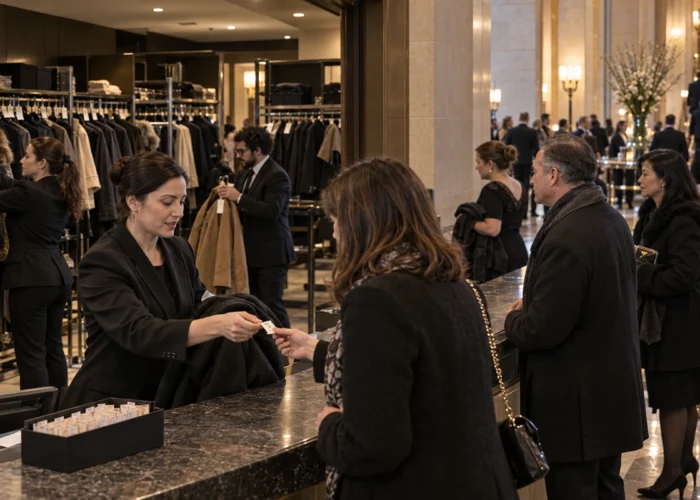
At a gala, holiday party, awards event, premiere, or winter reception, the attendant receives guest belongings, issues a numbered claim ticket, stores each item, and retrieves it when the guest leaves. Getting this right matters more as events get smaller and more intentional; our breakdown of emerging trends in corporate event planning for 2025 covers why organizers are investing more per guest even as headcounts shrink.
The difficult part is not hanging the coat. It is managing hundreds of belongings when guests arrive and then return for them at almost the same time.
That makes coat check staffing an operational issue, not simply a small hospitality line item, in much the same way that corporate event staff can shape a five-star guest experience without doubling the budget.
What Does A Coat Check Attendant Do?
A coat check attendant receives, tags, stores, and returns guest belongings. The role usually has three stages: preparation, active service, and closeout.
|
Phase |
Coat Check Attendant Responsibilities |
What The Host Decides |
|
Before doors |
Set up racks, check tags, organize positions, and prepare the station |
Station location, storage rules, lost-ticket process, and unclaimed-property owner |
|
Arrival |
Receive belongings, issue claim tickets, and store items |
Queue layout and number of retrieval points |
|
During event |
Maintain the station, handle re-checks, and retrieve items as needed |
Whether the station remains staffed throughout the program |
|
Departure |
Accept claim tickets and retrieve belongings |
Staffing level and exit-flow plan |
|
After event |
Reconcile remaining items and record unclaimed property |
Who takes custody of remaining items and for how long |
Before Guests Arrive
The attendant should begin with an organized station:
- Rack positions should follow a clear numbering system.
- Claim tickets should correspond with those positions.
- Oversized items should have a designated location.
The host should also establish the lost-ticket procedure before doors open. For example:
- Will a guest be asked to identify the item before it is released?
- Who approves the release?
- What happens if two guests claim the same item?
These decisions are much easier to make before the first guest arrives, and they matter even more at corporate events, where a C-suite guide to corporate event staffing in NYC, LA, and Chicago points out how much a single service breakdown can affect executive guests’ impression of the whole event.
During The Event
The basic coat check process is:
Receive → Tag → Store → Return.
However, the station may handle much more than coats. Guests may check:
- Coats and jackets
- Bags and briefcases
- Umbrellas
- Gifts and shopping bags
- Laptops and other electronics
Each additional item affects storage space and retrieval time.
Re-checks can create another workload. A guest may retrieve a coat to take something from a pocket and then check it again. A well-organized station needs to account for those transactions instead of assuming every guest checks one item once.
After The Event
The final responsibility is often forgotten.
Once most guests have left, staff need to:
- Reconcile the remaining items against the claim tickets.
- Log any unclaimed belongings.
- Transfer unclaimed items according to the event’s agreed procedure.
The host should assign that responsibility before the event. Otherwise, the question of who owns the remaining property becomes a last-minute problem. Unclaimed property piles up faster than most hosts expect: at Brussels Airport alone, nearly 32,000 lost items were logged in 2025, and only about 23% were ever returned to their owners, a reminder of how quickly ownerless belongings become a real problem once nobody is tracking them.
How Does A Coat Check Work?
A standard coat check uses a numbered claim system:
- A guest gives the attendant a coat or other item.
- The attendant attaches or assigns a numbered tag and gives the matching claim ticket to the guest.
- The item goes to the corresponding rack position.
- When the guest returns, the attendant takes the claim ticket and retrieves the item from that position.
The system works best when the ticket number maps directly to a numbered rack position.
That sounds basic, but it matters during the departure rush. An attendant who knows exactly where item 428 belongs can retrieve it much faster than someone searching through an unorganized rack. This is also why rack organization can be as important as headcount.
What Responsibility Comes With Holding Guest Property?
A coat check creates a different responsibility from a standard check-in desk.
Check-in verifies guests against a list. Coat check staff temporarily hold guests’ belongings.
Legal commentary on coat checks describes the relationship as a bailment, where one party holds another party’s property with an expectation that it will be returned. The same commentary discusses a paid coat check as a non-gratuitous bailment benefiting both parties and associates it with a duty of ordinary care.
This is general information, not legal advice. Specific responsibility can depend on local law, the venue contract, and the event’s insurance arrangements.
For event planners, the practical steps are more important:
- Keep the storage area controlled.
- Do not leave guest property in an open, unattended area.
- Establish a lost-ticket procedure before doors open.
- Document the process for missing items.
- Assign someone to handle unclaimed property.
- Review the venue contract and insurance arrangements before the event.
Do not assume a disclaimer sign, venue agreement, or insurance policy automatically resolves a particular loss. Review the actual documents and seek qualified legal advice when necessary.
How Many Coat Check Attendants Do You Need?
There is no universally accepted coat-check staffing ratio based on guest count alone. Instead, planners should consider:
- How many guests are likely to check belongings.
- How quickly guests arrive.
- How quickly they will leave.
- How the racks are organized.
- How many retrieval points the station has.
- Whether the event has a hard ending.
- Whether guests are checking bags and oversized items.
One useful PremierStaff planning figure is that approximately 60% to 80% of guests arrive within a 60-to-90-minute window for many events.
The departure pattern can be much sharper. When a keynote ends, an awards program closes, or the venue reaches its scheduled finish, many guests want their belongings immediately. That means a station sized only for arrivals can struggle when the event ends. The same principle applies to other guest-facing stations under time pressure: our guide on how many bartenders you need works through a nearly identical flow-versus-headcount problem at the bar.
Coat Check Staffing Planning Estimates
The following table is a planning framework, not a published industry standard. Actual staffing should be adjusted for the event format, season, expected check rate, venue layout, rack organization, and departure timing. The supplied brief notes that no published source provides a universal retrieval rate or coat-check staffing ratio.
|
Guest Count |
Estimated Items In A Winter Formal Event |
Planning Attendants |
Retrieval Points |
Departure Planning |
|
Under 100 |
70–100 |
1 |
1 |
A compact station may be sufficient |
|
100–250 |
80–225 |
2 |
1–2 |
Allow space for a short exit queue |
|
250–500 |
200–450 |
3–4 |
2–3 |
Multiple retrieval points become important |
|
500+ |
400–500+ |
4–6+ |
3+ |
Plan around venue layout and the event’s hard stop |
These figures should be treated as starting points rather than fixed ratios.
A winter black-tie event may have a very high check rate. A summer reception may have far fewer checked items. Winter events also tend to carry bigger budgets than planners expect. Christmas party spend alone was up 5% year-over-year in 2026 even as overall enquiry volume held flat, which is one more reason to staff the coat check for the formality of the event, not just the headcount.
Bags and oversized belongings can also increase the required storage space and retrieval time.
Example: A 150-Guest Winter Gala
Imagine a 150-person corporate gala in December:
- Most guests arrive in formal clothing with coats.
- The event has a scheduled 10:30 p.m. ending after the final awards.
- The station might be manageable with two attendants, provided the racks are organized and the venue provides enough space for more than one retrieval point.
The important issue is not the 150-person headcount by itself. It is what happens between 10:30 and 10:45 p.m. If most guests leave immediately, the coat check needs to be ready for that concentrated demand.
Example: A 500-Guest Black-Tie Event
Now consider a 500-person awards event with a firm midnight venue close:
- Even if the coat check handles arrivals comfortably, the final fifteen minutes can create a significant queue.
- A larger station needs enough attendants and retrieval points to keep the queue moving.
- It also needs a rack layout that lets staff find items without searching through hundreds of garments.
This is where retrieval design becomes as important as headcount.
Why The Departure Rush Matters More Than The Arrival Peak
Arrival and departure are fundamentally different. Guests arrive over a window. Departures often happen at once.
PremierStaff’s published registration-staffing guidance uses a 60-to-90-minute arrival window as a planning reference. A coat check cannot assume the same pattern on exit. If the program ends at 11 p.m., guests do not normally agree to leave in several waves so the coat check can keep up. They all want their belongings.
That creates the most important planning rule for coat check staffing:
Size the station for the departure rush, not just the arrival flow.
The number of attendants matters, but so does the number of retrieval points. Two people standing behind one narrow counter may still create a bottleneck. A well-designed station gives staff enough physical access to retrieve multiple items efficiently.
The stakes are similar to what happens at a check-in desk on the way in. Research on onsite registration shows attendees judge an entire event by how frictionless that first interaction feels, and the same is true in reverse: a slow, disorganized coat check is often the last interaction a guest has with the event.
Are Coat Checks Still A Thing?
Yes. Whether an event needs one depends largely on season, formality, venue, and guest behavior.
- A winter black-tie gala may need a staffed coat check even with a relatively small guest count.
- A summer outdoor reception may need nothing more than a limited rack or no coat storage at all.
- For a smaller informal event, a self-service rack can be a reasonable option. However, planners should recognize that an unattended storage area creates a different risk profile from a staffed station.
The decision should therefore be based on the event experience you want to provide and how much guest property the event expects to hold.
What Can Go Wrong With Coat Check Staffing?
Four problems appear repeatedly in poorly planned stations.
1. The Exit Queue
The event ends successfully, but guests spend the final part of the evening waiting for their belongings. The coat check becomes the final impression of the event.
2. An Unattended Rack
The event saves staffing costs but leaves guest belongings in an open area without active supervision. The apparent saving can create an operational and responsibility issue.
3. A Lost Claim Ticket
A guest cannot find the ticket while other guests are waiting. Without a pre-agreed procedure, the attendant has to make a decision while managing a queue.
4. Unclaimed Property
One or more items remain after the room clears. If no one was assigned to handle them, the event ends without a clear handoff.
All four problems can be addressed before doors open, the same way a corporate retreat can be staffed without visible service gaps when every station has a clear owner from the start.
How Should You Set Up A Coat Check?
A successful coat check starts with five decisions.
1. Decide Whether The Service Is Free Or Paid
Make this decision before the event. If guests pay for the service, understand that the arrangement may carry different legal considerations. Review the issue with qualified counsel when appropriate.
2. Choose The Right Location
Place the station close enough to the entrance for convenience, but do not allow the queue to block doors or major guest pathways.
3. Number The Racks In Sequence
This is one of the simplest improvements you can make. The claim ticket should lead staff directly to the rack position. The less searching staff do, the faster the departure process becomes.
4. Write The Lost-Ticket Procedure
Do not wait for the first lost ticket to decide what happens. Give staff a clear procedure and identify who can approve an exception.
5. Assign Unclaimed Property
Name the person or team responsible for remaining belongings after the event. Also document where the items go and what happens next. Weddings raise the same ownership question with gifts and personal items left at a card table, which is one of the line items covered in our guide to what buffet vs. plated wedding staffing actually costs.
Coat Check Staff Vs. Check-In Staff
Coat check staff and check-in staff may work beside each other, but they have different responsibilities:
- Check-in staff: Verify guests, manage registration, distribute credentials, and direct arrivals.
- Coat check staff: Receive and store personal belongings, issue claim tickets, and retrieve property during departure.
The distinction matters because the two stations can experience different workload patterns. A registration desk may have its biggest demand before the program starts. Coat check may have its most difficult workload when the program ends. Planning them as one generic hospitality function can therefore lead to the wrong staffing allocation.
What Should Event Planners Look For?
Before the event, confirm that the coat check plan has:
- A station sized for the departure rush
- Enough physical queue space
- Sequentially numbered rack positions
- A clear claim-ticket system
- A written lost-ticket procedure
- A plan for oversized belongings
- A procedure for re-checks
- Controlled access to stored property
- An assigned owner for unclaimed items
- Enough retrieval points for the expected exit volume
Avoid relying on guest count alone. A 200-person winter gala with a hard ending can create more coat-check pressure than a larger summer reception with a gradual departure.
Plan The Coat Check Before The Event
A coat check attendant may work at one of the smallest stations in the venue, but the station carries real operational responsibility.
The biggest mistake is planning only for arrivals. The harder challenge usually comes when the program ends and a large portion of the room wants their belongings at once.
Plan the rack layout, retrieval points, lost-ticket procedure, staffing level, and unclaimed-property process before doors open.
Planning a staffed coat check? Contact the Premier Staff team with your guest count, event date, season, venue, and program end time so the station can be planned around the actual flow of the evening.
What Does A Coat Check Attendant Do?
A coat check attendant receives, tags, stores, and returns guests’ belongings. The role also includes managing the station during arrival and departure, handling re-checks, and reconciling unclaimed property after the event. This is one of the core functions covered by Premier Staff’s hospitality staff at galas, receptions, and formal events.
What Are The Main Coat Check Attendant Responsibilities?
The main responsibilities include setting up the station, issuing numbered claim tickets, organizing rack positions, storing belongings, retrieving items, handling lost tickets according to the event procedure, and recording unclaimed property. The ticketing and reconciliation side of the job overlaps closely with what Premier Staff’s check-in teams handle at the front of the house.
How Does A Coat Check Work?
A guest gives an item to the attendant and receives a numbered claim ticket. The item is stored in the corresponding rack position. When the guest returns, the attendant uses the ticket to locate and return the item. Premier Staff’s hospitality staff are trained to run this process smoothly even during a high-volume departure.
How Many Coat Check Attendants Do You Need?
There is no universal ratio. Start with guest count, expected coat-check rate, venue layout, rack organization, number of retrieval points, and the expected departure rush. Winter formal events generally require more planning than summer receptions. Premier Staff’s crowd management teams can help size retrieval points and exit-flow staffing around your event’s actual departure pattern.