

Daniel M., CEO - Premier Staff
Want to Elevate Your Brand Ambassador Staffing Agency NYC Plans?
Concession stand staffing should operate as a high-efficiency revenue engine, not a last-minute operational add-on. Top-performing events treat staffing strategy as a direct driver of sales, speed, and guest satisfaction.
Executive Summary
Concession stand staffing plays a critical role in event profitability, directly influencing service speed, crowd flow, and per-capita spend. This guide outlines how concession staffing works, key roles and certifications required, and optimal team structures for high-volume events. It also highlights hiring strategies, common pitfalls, and performance insights to help planners avoid lost revenue. For large-scale events, structured staffing models and certified teams are essential to maintaining efficiency under peak demand.
Introduction
Concession stand staffing is one of the most overlooked yet revenue-critical parts of any event. From stadium games to music festivals, the speed, compliance, and coordination of concession workers directly impact guest experience and your bottom line. If you’ve ever waited 20 minutes for a drink or missed part of a show in line, you’ve experienced poor concession staffing firsthand.
This guide breaks down exactly what concession stand staffing looks like, the roles involved, and how to hire the right team.
What Does Concession Stand Staffing Look Like at Events
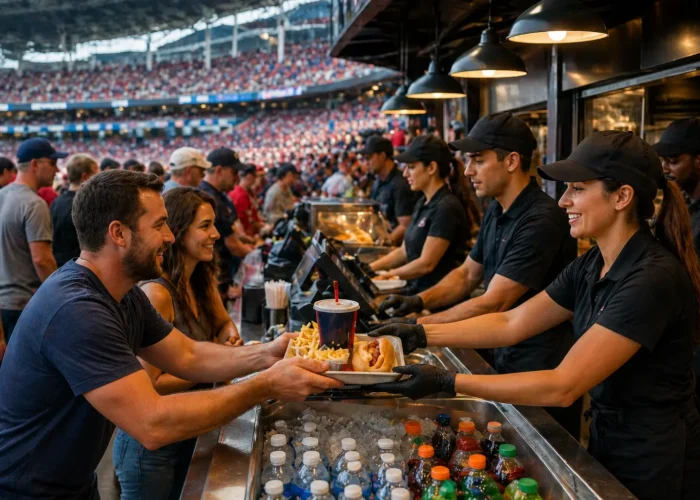
Concession stand staffing is one of the most revenue-critical and operationally sensitive components of any large-scale event. At stadiums and festivals, poor concession staffing doesn’t just create long lines it directly leads to lost sales, negative guest experiences, and crowd flow issues.
The numbers back this up. According to a 2025 Mashgin report, over 80% of fans have abandoned a concession purchase because lines were taking too long a direct, measurable hit to revenue. Yet most event teams underestimate how specialized concession staffing actually is.
This guide breaks down:
- What concession stand staffing includes
- Key concession staff roles and certifications
- How many workers you actually need per stand
- How to hire reliable, high-volume concession teams
How Concession Staffing Differs From Catering Staff
While both involve food service, concession staffing and catering staff serve very different operational models.
Concession Staffing
- Fixed-location stands inside venues
- High-speed transactions (think seconds, not minutes)
- Limited menu (hot dogs, drinks, snacks)
- Focus on volume and efficiency
Catering Staff
- Mobile or distributed service (buffets, trays, VIP areas)
- More personalized guest interaction
- Broader menu and presentation focus
- Emphasis on hospitality over speed
👉 Example: At a football stadium, concession workers may serve 300–500 customers per hour per stand, while catering staff in a VIP lounge serve fewer guests but with higher service expectations. Understanding the difference between these two roles is something we cover in depth in our guide to best practices for staff training in large-scale catering.
Insight: Event organizers often underestimate this difference and under-hire for concession stands, leading to long queues, lost sales, and frustrated attendees. Food and beverage is one of the biggest revenue drivers in any venue: drinks alone often carry profit margins exceeding 90%, which means every minute of slow service has a real cost.
Concession Stand Staffing Roles And Responsibilities
A successful concession setup isn’t just one or two people behind a counter. It’s a coordinated micro-team designed for speed, compliance, and accuracy.
Concession Staff Roles From Cashier To Supervisor
Below is a breakdown of key concession staff roles, their responsibilities, and required certifications:
Role | Duties | Certifications Needed |
Cashier | Takes orders, processes payments, and manages POS systems | Basic food safety (sometimes optional) |
Food Prep Worker | Prepares food items (grill, fryer, assembly) | Food handler certification |
Runner / Stocker | Restocks inventory, refills drinks, supports flow | None (preferred basic training) |
Beverage Server | Handles drinks (alcohol/non-alcohol), maintains speed | Alcohol service certification (if applicable) |
Stand Supervisor | Oversees operations, handles issues, and ensures compliance | Food safety + supervisory experience |
Insight: The most efficient stand separate roles clearly. For example:
- One person only handles payments
- One or two focus purely on food prep
- One runner keeps inventory flowing
This assembly-line setup can double throughput compared to multitasking staff.
👉 Real-world use case: At large concerts, high-performing concession teams use a “two-line system,” one for ordering, one for pickup, to reduce congestion and increase speed. Speed matters enormously: fans globally say they would spend at least 30% more on food and beverage if wait times were cut in half, according to Oracle’s Stadium of the Future report.
How To Hire Concession Staff For Your Event
Hiring the right concession workers isn’t just about filling positions; it’s about ensuring speed, compliance, and reliability under pressure. The same principles that apply to hiring line cooks fast apply here: pre-vetting, certifications, and a staffing pipeline that doesn’t leave you scrambling at the last minute.
Where To Find Food Handler-Certified Concession Workers
Here are the most effective sourcing options:
- Staffing Agencies (Recommended)
- Provide pre-trained, food handler-certified workers
- Can scale quickly for large events
- Handle scheduling, replacements, and compliance
- Local Event Staffing Pools
- Freelance workers with prior event experience
- More cost-effective but less consistent
- Venue-Preferred Vendors
- Some stadiums require approved concession teams
- Ensures compliance but limits flexibility
Typical Team Size Per Stand
A standard concession stand typically requires:
- Small events: 4 staff per stand
- Medium events: 5–6 staff per stand
- Large/high-traffic events: 6–8 staff per stand
Example Setup (6-person team):
- 2 cashiers
- 2 food prep workers
- 1 runner
- 1 supervisor
Insight: Understaffing by even one person can slow service by up to 30–40% during peak hours, especially when lines spike during halftime or intermissions. This directly impacts revenue: 45% of fans have given up buying food or beverages at least once in the past 12 months because lines were too long, according to Datassential.
Key Hiring Considerations
Before you hire concession stand staff, ensure:
- Food safety compliance: Workers have valid food handler certifications. Food handler certification within 14–60 days of hire, and some states like California now require employers to cover the cost of that training entirely.
- Speed under pressure: Experience in high-volume environments
- Cash handling accuracy: Especially for large events
- Reliability: No-shows can cripple operations
👉 Pro tip: Always overbook by 10–15% to account for last-minute drop-offs. For events that also need crowd management alongside food service, it’s worth reading our breakdown of gameday activation staffing for sports sponsors to see how these roles coordinate on the ground.
Final Thoughts
Concession stand staffing isn’t just a support function—it’s a revenue engine and a key part of the attendee experience. Well-staffed stands mean faster service, higher sales volume, better crowd flow, and happier guests. Poor staffing, on the other hand, leads to long lines, missed moments, and lost revenue you can’t recover.
Need Concession Stand Staffing That Can Handle Volume?
If you’re planning a stadium event, festival, or large-scale activation, staffing gaps can cost you thousands in lost sales.
Premier Staff provides trained, food handler-certified concession teams built for high-speed, high-volume environments. From cashiers to full stand crews, we help you scale quickly, stay compliant, and maximize revenue per stand.
👉 Get in touch to secure your concession staff early.
How Many Concession Workers Do You Need Per Stand?
Most events require 4–8 concession workers per stand, depending on traffic volume. High-demand periods like halftime or intermissions often require additional staff to maintain speed and reduce wait times. If you’re staffing a stadium or large festival, Premier Staff’s stadium event staffing team can help you determine the right crew size for your venue and expected guest volume.
What Certifications Do Concession Workers Need?
At a minimum, concession workers typically need a food handler certification. If alcohol is served, staff may also require alcohol service certifications based on local regulations. Premier Staff’s catering staff arrive pre-certified and compliant, so you don’t have to manage the paperwork yourself.
What Are The Main Concession Staff Roles At Events?
Key concession staff roles include cashiers (order taking and payments), food prep workers (cooking and assembly), runners/stockers (inventory and support), beverage servers (drinks and alcohol service), and supervisors (operations and compliance). For events that also need floor coverage and crowd direction, Premier Staff’s hospitality staff can be deployed alongside concession teams to keep the entire guest experience running smoothly.
How Is Concession Stand Staffing Different From Catering Staffing?
Concession stand staffing focuses on high-speed service at fixed locations, while catering staffing emphasizes guest experience and mobile service. Concession teams are built for volume, whereas catering teams are built for presentation and interaction. If your event includes both a concession operation and a sit-down or VIP service component, Premier Staff offers dedicated catering staff that can run alongside your concession crew.