

Daniel M., CEO - Premier Staff
Want to Elevate Your Brand Ambassador Staffing Agency NYC Plans?
A successful grand opening needs more than employees at the door. It requires the right mix of brand ambassadors, greeters, street teams, hospitality staff, and floor teams.
What Staff Does a Grand Opening Need?
A grand opening needs more than people at the door. A well-staffed opening typically includes brand ambassadors or promotional staff, greeters, floor staff, hospitality staff, and a lead. Depending on the venue, you may also need a street team, sampling staff, or crowd-control support.
The key is to plan for two different parts of the event: the ribbon-cutting ceremony and the public opening. The ceremony needs focused hospitality and VIP support, while the public day needs staff who can welcome guests, manage movement, promote the opening, and keep the entrance active.
Because grand-opening attendance is difficult to predict, staffing should be built around a forecast range rather than one fixed headcount. Start with a core team for expected traffic, then keep a trained flex team available if footfall increases.
This guide explains which staff roles you need, how many people to plan for, and how to structure coverage from the ribbon cutting through closing time.
Executive summary
A grand opening typically needs brand ambassadors, street teams, greeters, hospitality staff, floor staff, and a lead. Additional sampling, demo, or crowd-control staff may be needed based on the event format and expected traffic.
The best approach is to separate staffing for the ribbon-cutting ceremony from the public opening. Build a core team around expected footfall, then keep flex staff ready to handle unexpected demand.
A Grand Opening Is the Only Event Without a Guest List
Every other event you staff starts from a number. A gala has 300 covers. A conference has a registration list. A private party has an invite list you can count. A grand opening starts from a guess.
- No benchmark exists. Even Shopify’s own retail-launch guidance is simply to invite enough people to “mimic real customer traffic,” with no number attached. Shopify’s retail foot traffic data shows in-store visits grew just 0.4% year-over-year in 2024, proof that footfall is stable industry-wide but unpredictable store by store, which is exactly what makes one opening day so hard to forecast.
- So you staff to a range, not a count. A core team covers the full day; a smaller flex group stays briefed and ready but off the floor until you see how the morning goes. See our guide to retail activation ideas for what actually pulls that footfall in.
- There’s no check-in desk. A gala or conference has one point to count people and control pace. A public opening has no such gate, so flow management moves onto the floor and sidewalk, a different skill set than running check-in staff at a gated event.
- Your staff affects attendance. A brand ambassador or street team on the sidewalk changes how many people walk in while the event is still running, something no other event type does. It’s why global experiential marketing spend hit $128.35 billion in 2024, its first year above pre-pandemic levels, and why cutting sidewalk presence is the most expensive mistake on this list. More on this in how in-store marketing turns shopper hesitation into sales.
It also isn’t one event. It’s two, running inside each other.
Two Events, Two Clocks
|
Ribbon Cutting |
Public Open Day |
|
|
How long |
1–2 hours |
4–8 hours |
|
Who’s there |
Owners, local officials, chamber reps, press, key staff |
Anyone who walks in |
|
Do you know the headcount? |
Roughly |
No |
|
Roles needed |
Greeters, hospitality, MC/order-of-events, refreshments |
Brand ambassadors, street team, greeters, floor staff |
|
Where the staff are |
Clustered around the ceremony |
Spread across sidewalk, door, floor |
|
What goes wrong |
Gets no dedicated staff, since everyone’s focused on the crowd |
Thins out the moment the ceremony pulls attention |
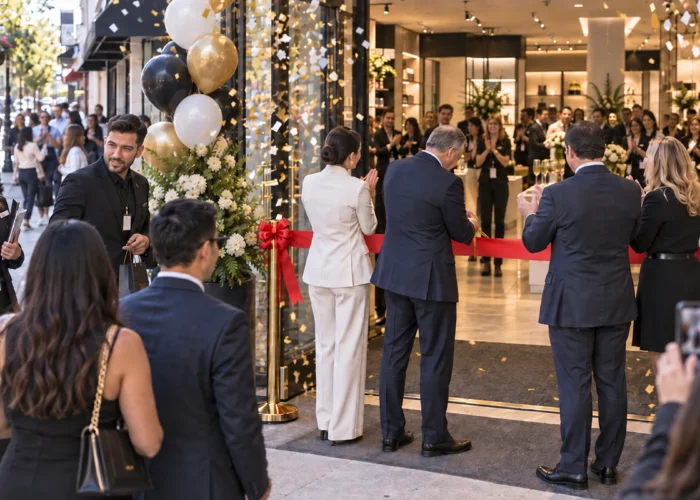
The ribbon cutting is short and formal:
- According to MemberClicks’ ribbon-cutting planning guide, ceremonies typically run one to two hours and are usually scheduled early-to-mid afternoon, to catch both foot traffic and good light.
- The audience is invited and small: owners, local officials, chamber-of-commerce representatives, press, key staff, sometimes landlords or investors.
- The roles it needs are hospitality roles: someone greeting and directing arrivals, someone looking after the VIPs and press specifically, someone holding the running order who can tell the mayor where to stand, and someone handling refreshments.
- It’s the closest thing in the day to a private event, and it’s usually the part that gets no dedicated staff at all, because everyone’s attention is on the public crowd instead.
The public day is long and open:
- Air Fresh Marketing, one of the few publishers who’ve written specifically about staffing grand openings, puts the public portion at four to eight hours and adds one detail worth building your own plan around: brief all staff at least an hour before doors open to review roles, talking points, and emergency procedures. That single instruction is the most useful line published on this topic anywhere.
- The audience for this stretch of the day is unknown and arriving continuously, and most of them are deciding whether to come in while they’re still standing outside.
- That calls for a different set of roles: sidewalk presence, sampling or giveaway distribution, queue and flow management inside, and enough hospitality that the space feels staffed rather than crowded.
- If you’re opening alongside a new product rather than just a location, the staffing logic overlaps closely with product launch event staffing, where the same guest-journey thinking applies.
The overlap is the part that trips people up. The ceremony happens during the public day, which means for that one hour the same physical space is serving two audiences with completely different expectations: a formal moment for the cameras, and a public crowd that doesn’t know or care about it. That hour is the one to over-staff, not the one to thin out.
Which gives you a role list.
The Roles a Grand Opening Needs
|
Role |
Where They Work |
Purpose |
|
Brand ambassadors / promotional staff |
Sidewalk, entrance |
On-message, delivering the offer, drawing people in |
|
Surrounding blocks |
The only role whose job is to increase attendance |
|
|
Door |
Orient people who’ve just decided to come in |
|
|
Hospitality staff |
Ceremony, VIP/press group |
Ceremony service, refreshments |
|
Sampling / demo staff |
Floor, entrance |
Product in hand, where there’s something to hand out |
|
Floor staff |
Interior |
Keep movement working, space feeling open |
|
Lead / captain |
Floor |
One per eight staff; decides when to shift flex team to the sidewalk |
|
Frontage, entrances |
Where forecast is large or the street is busy |
- Brand ambassadors / promotional staff are the front line, on the sidewalk and at the entrance, on-message and briefed on the offer. This is usually the largest single line item, and the one most openings under-book, because it’s easy to assume the interior team is enough. Read more on how brand ambassador agencies work if you’re sourcing this role for the first time, or see where companies actually find brand ambassadors if you’re building an ongoing bench rather than a one-off booking.
- Street team works the surrounding blocks rather than the doorway, and it’s the only line item on this list whose entire purpose is increasing attendance rather than serving people who are already there. They’re typically booked in pairs and given a defined radius, rather than left to roam. The same discipline that makes grassroots marketing campaigns work, the right people representing the brand at street level, is what makes a street team effective on opening day.
- Greeters sit at the door and pick up where the street team leaves off, orienting people the moment they’ve decided to come in.
- Hospitality staff and hostesses cover the ceremony, the VIP and press group, and refreshment service, the part of the day that most resembles a traditional private event.
- Sampling or product-demo staff belong on the list where there’s an actual product to put in someone’s hand.
- Floor and flow staff work the interior, keeping movement working and the space feeling open rather than congested.
- A lead or captain runs every eight floor staff, a standard staffing ratio, and at a grand opening, the lead also makes one judgement call the whole day turns on: when to pull people off the flex bench and move them to the sidewalk as traffic changes. Name that decision explicitly when you brief the lead; it’s not a minor detail.
- Crowd control belongs on the list where the forecast is large or the frontage sits on a busy street.
One honest note on the venue’s own new hires: they’re learning the business on the same day a crowd shows up, and asking them to double as event staff is how openings end up with nobody outside. That’s not a shortcoming on their part. It’s simply two jobs at once, and the sidewalk is the one that gets dropped.
Here’s how this plays out in practice. A single-frontage retail opening on a busy street corner, expecting 300 to 400 people across a six-hour public day, with a 1 p.m. ribbon cutting:
- Four brand ambassadors split across the sidewalk and entrance
- A two-person street team working the block in each direction
- Two greeters rotating the door
- Three hospitality staff covering the ceremony hour specifically
- Four floor staff
- One lead who moves people between the sidewalk and the floor as the day’s traffic shifts
Add a second street-facing entrance, and the sidewalk line doubles, not because the venue got bigger, but because there’s now a second face of the building that needs its own presence.
The only question left is how many.
How Many, When You Don’t Know Who’s Coming
|
Expected Footfall |
Brand Ambassadors |
Street Team |
Greeters |
Hospitality (Ceremony) |
Floor Staff |
Leads |
|
Under 200 |
2 |
2 |
1 |
2 |
2 |
1 |
|
200–500 |
4 |
4 |
2 |
3 |
4 |
1 |
|
500+ |
6+ |
6 |
3 |
4 |
8 |
1 per 8 |
These are planning estimates drawn from staffing openings, not a published industry standard. No association or retail body publishes grand-opening staffing ratios. Staff the bottom of your forecast range, hold flex for the peak, and round up.
The method is more useful than any single number: forecast a range, staff the bottom of it as your core team, and hold a flex group in reserve for the top. That’s planning judgement, not a formula. Nothing else exists to plug in here, because nobody, including the largest retail-operations publishers, will put a hard figure on opening-day attendance.
Three things move the number, and each is worth a whole person rather than a fraction of one:
- Every additional entrance or street frontage needs its own presence; it’s not something you can split across an existing role.
- A giveaway or sampling component roughly doubles the sidewalk team, because every interaction takes longer once there’s a physical handout involved.
- The ceremony hour needs its own hospitality cover, on top of whatever the public day already has running.
Keep the lead ratio consistent with your standard event staffing: one per eight floor staff.
On timing, there’s one number worth anchoring to: Air Fresh Marketing’s guidance to brief all staff at least an hour before doors open. At a grand opening, that brief has to cover more than logistics. It needs the offer, the talking points, and where the ceremony is happening, because promotional staff are effectively speaking for the brand to people who’ve never heard of it. The same lead-time discipline applies to booking: our guide on when to book event staff covers why booking closer to the date almost always costs more and limits who’s available.
Nobody can tell you how many people will come to an opening, which is why the team is built as a core plus a flex group rather than a single number. Send the location, the frontage, the ceremony time and your best guess at footfall, and the team comes back split: sidewalk, door, floor and the ceremony hour.
Three things go wrong at openings, and they’re all avoidable.
What Goes Wrong on Opening Day
- Nobody outside. This is the most common and most expensive mistake. Everyone’s inside looking busy, the sidewalk is empty, and the people walking past, the entire point of the day, keep walking. A store with staff visible outside converts passers-by. A store with a full interior and an empty doorway does not.
- The ceremony ambushes the day. The mayor arrives, three staff peel off to manage it, and the floor thins out at exactly the moment there are press cameras in the room. This is precisely what dedicated ceremony-hour cover exists to prevent.
- The new employees are working their first shift. They’re learning the till, the menu and the stockroom while a crowd is in the building. Using them as event staff means the business’s first day is also the day it looks least competent, and it’s a false economy, since event staff cost less than the impression does. On top of that, the brief matters more here than at almost any private event: promotional staff are talking to people who’ve never heard of the brand, while private-event staff are mostly serving people who already know why they came.
What To Look For, What To Avoid, What Matters Most
Look for:
- A team split between the ceremony and the day
- Visible presence outside from the moment doors open
- A flex group briefed but not booked to the floor
- One lead per eight staff
Avoid:
- Staffing to a single guessed number
- Letting the ceremony pull people off the floor
- Using first-day employees as event staff
- A brief that covers logistics but not talking points
What matters most: a grand opening is the one event where the staff change how many people attend. Everything else on the list is service. The sidewalk is marketing, and it’s the line most openings cut first.
The Bottom Line
A successful grand opening needs staffing that supports both the ceremony and the customer experience.
Plan for a dedicated hospitality team during the one-to-two-hour ribbon cutting, along with a larger public-facing team for the four-to-eight-hour opening. Use brand ambassadors, street teams, greeters, and floor staff to manage the guest journey, then add sampling or crowd-control staff when the event requires them.
Most importantly, do not staff to one guest attendance number. Build a core team around your expected footfall and keep trained flex staff available for unexpected traffic.
Need help building your grand-opening staffing plan? Share your expected footfall, event duration, ceremony time, number of entrances, and venue location. A professional staffing team can then map coverage across the sidewalk, entrance, floor, ceremony, and contingency needs.
How long does a grand opening last?
The public portion typically runs four to eight hours. The ribbon-cutting ceremony inside it runs one to two hours and is usually scheduled early-to-mid afternoon. Since that hour needs dedicated coverage on top of the public day, most openings book a separate hospitality staff team for the ceremony rather than pulling floor staff off the sidewalk.
What's the difference between a soft opening and a grand opening?
A soft opening is a rehearsal, a limited launch to test service and collect feedback, usually with your own team practicing. A grand opening is the public launch, built to announce the business and attract customers, typically over a single day or weekend, and it needs promotional staff rather than internal employees still learning the business.
What do people do at grand openings?
A grand opening usually has two parts: a ribbon-cutting ceremony with remarks, the ribbon cut, photos and refreshments, attended by owners, officials, chamber representatives and press, and a public open day with giveaways, sampling, demonstrations or offers, open to anyone who walks in and typically worked by brand ambassadors drawing people toward the entrance.
What staff does a grand opening need?
Brand ambassadors or promotional staff for the entrance and sidewalk; a street team working the surrounding blocks; greeters at the door; hospitality staff for the ribbon cutting, VIPs and press; sampling or demo staff if there’s a product to hand out; floor staff managing flow inside; and one lead or captain for every eight floor staff. Crowd control is added where the frontage is busy or the forecast is large.