
- 12 Corporate Team Building Events for Large Groups
12 Corporate Team Building Events for Large Groups
Most “large group” team building lists are written for about twenty people. Above 100, the problem changes: you need formats that can handle simultaneous participation, large spaces, multiple facilitators, and people who may not participate.
That is why choosing corporate team-building events for large groups requires more than finding a fun activity. You need to know whether the format can split into smaller groups, how long it takes, and what it takes to run across the venue. It’s not a minor concern, either. Global employee engagement fell to just 20% in 2025, its lowest level since 2020, according to Gallup’s State of the Global Workplace: 2026 Report, which puts real weight behind getting an in-person event right instead of treating it as a throwaway afternoon.
PremierStaff staffs events, but we do not sell the activities listed below. The space, timing, and staffing figures are planning estimates based on operational experience, not published industry standards.
Start by finding your number.
Executive Summary
- Large-team activities need to work across 100 to 600+ employees without creating queues or participation gaps.
- This guide compares 12 corporate team building events for large groups by headcount, space, duration, and staffing needs.
- It also explains how sub-groups, station rotations, floor plans, and event staffing affect execution.
- Use these practical guidelines to choose a format that fits your team building events for large teams and your event setup.
Large corporate team building events for large groups require more than choosing a fun activity. This guide covers 12 scalable formats and the space, timing, sub-groups, and staffing each one takes to run.
— Daniel Meursing, CEO of Premier Staff
Headcount should determine the format before the activity does. A game that works well for 20 people can become a queue-management problem at 200.
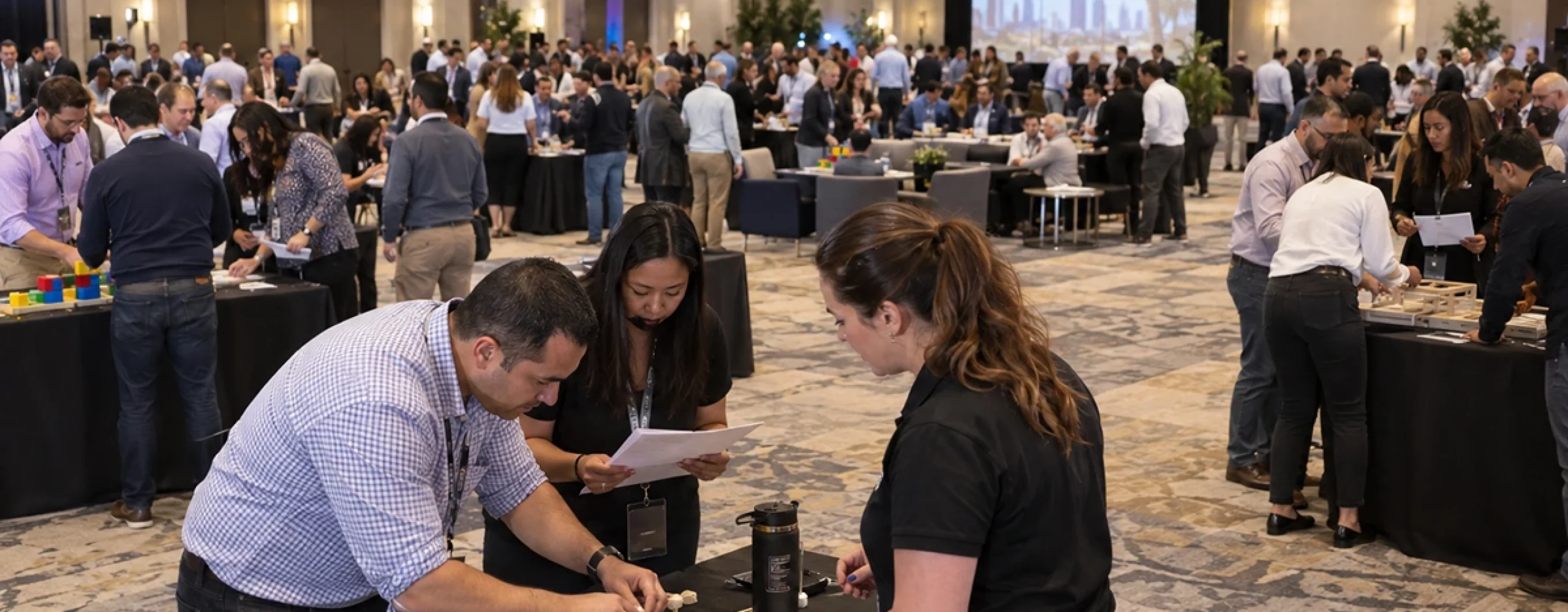
The most reliable team building activities for 100 employees use smaller breakout teams that operate at the same time. Teams of roughly 8 to 12 people can compete, solve, build, or rotate without forcing hundreds of employees into one activity. A mix of structured games and looser icebreakers and energizer activities tends to work best. This is the same logic that shapes every list of corporate team building events for large groups worth using at scale.
Format | Works At | Space Needed | Runs For | Staff / Facilitators | Sub-Groups? |
Casino Night | 100–250 | Large ballroom or event floor | 2–3 hours | 1 per 2–3 tables or stations | Yes |
Trivia Night | 100–250 | Seated room with stage or screens | 60–90 minutes | 1 host + floor support | Yes |
Cooking Competition | 100–250 | Kitchen or large stationed room | 2–3 hours | 1 per station | Yes |
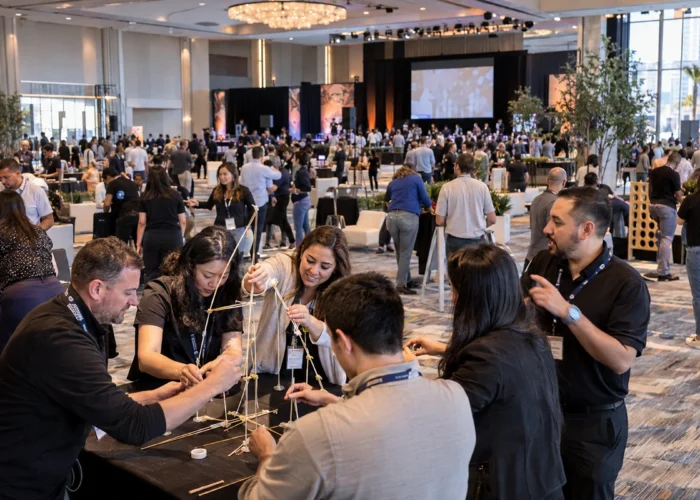
Charity Build | 100–250 | Large open room | 2–3 hours | 1 per 2–3 stations | Yes |
Field Day | 250–500 | Large outdoor field | 2–4 hours | 1 per station | Yes |
Game Show | 250–500 | Ballroom with stage | 90–120 minutes | Host + floor team | Yes |
Scavenger Hunt | 250–500 | Venue, campus, or district | 2–3 hours | 1 per zone/checkpoint | Yes |
Interactive Breakouts | 250–500 | Ballroom with breakout areas | 90–150 minutes | 1 per breakout group | Yes |
Company Field Day | 500+ | Large outdoor site | 3–5 hours | Station teams + event leads | Yes |
Festival Activity Zones | 500+ | Large outdoor or indoor site | 3–5 hours | 1 per zone + floor leads | Yes |
Stage-Led Game Show | 500+ | Large ballroom or auditorium | 90–150 minutes | Host + floor team | Yes |
Multi-Site Volunteer Day | 500+ | Multiple locations | 3–6 hours | Site leads + central lead | Yes |
The numbers above are planning estimates. Actual requirements change with the venue, activity design, arrival pattern, accessibility needs, and event schedule.
Three mechanics matter most for any of these corporate team building events for large groups:
- Decide whether everyone participates at once. Above roughly 150 people, many formats need waves or rotations. That is fine if the schedule accounts for it. It becomes a problem when half the room is left waiting.
- Use sub-groups. If a format cannot divide 400 people into smaller teams working in parallel, it probably does not scale well. This is one of the fastest ways to eliminate unsuitable large group team building ideas.
- Plan for non-participants. Not every employee will want to compete, cook, run, build, or move between stations. A format works better when spectators have somewhere to sit, talk, eat, or observe.
With those constraints in mind, here are 12 corporate team building events for large groups that can work at larger headcounts.
12 Corporate Team Building Events That Actually Scale
100–250 People
- Casino Night
A casino night can support several groups at once because participants move between tables rather than waiting for one central activity. It’s a solid entry point among corporate team building events for large groups because it scales down easily too.
Teams can rotate through different games or compete using a shared scoring system. The format also gives non-participants room to socialize without disrupting the activity.
- Works at: 100–250 people
- Space: Large ballroom or event floor
- Runs: 2–3 hours
- Staffing: Roughly one activity staff member per 2–3 tables, plus a floor lead
- Watch for: Crowding around popular tables
- Trivia Night With Themed Rounds
Trivia is easier to scale when employees compete in teams instead of answering individually. Tables of 8–10 people can mix departments, locations, or job functions, a format that works equally well as one of many team building activities for 100 employees.
A central host controls the program while floor staff handle answer collection, questions, scoring support, and movement.
- Works at: 100–250 people
- Space: Seated room with screens and stage area
- Runs: 60–90 minutes
- Staffing: One host plus floor support for scoring and table assistance
- Watch for: Slow scoring or unclear instructions between rounds
- Cooking Or Mixology Competition
Station-based cooking competitions give large groups a physical task without requiring everyone to work in one space.
Each team gets its own station, instructions, and time limit. The format works particularly well when the venue already has appropriate kitchen infrastructure or temporary stations can be installed safely, another reliable option in the team building activities for 100 employees category.
- Works at: 100–250 people
- Space: Large room with separated stations
- Runs: 2–3 hours
- Staffing: One facilitator per station
- Watch for: Insufficient workspace, equipment, or circulation room
- Charity Build
Charity builds divide employees into teams that assemble useful items such as care packages, school supplies, or other donated goods.
The parallel structure makes the format practical for larger companies and a dependable choice among corporate team building events for large groups. Teams can work at separate tables while a central lead controls instructions, timing, materials, and handoffs.
- Works at: 100–250 people
- Space: Large open room with substantial table space
- Runs: 2–3 hours
- Staffing: One facilitator per 2–3 stations, plus a lead
- Watch for: Running out of materials or creating bottlenecks at the collection area
250–500 People
At this size, the event starts behaving more like a production. The activity itself may be simple, but movement, timing, staffing, and floor coverage become major planning issues for any of these corporate team building events for large groups.
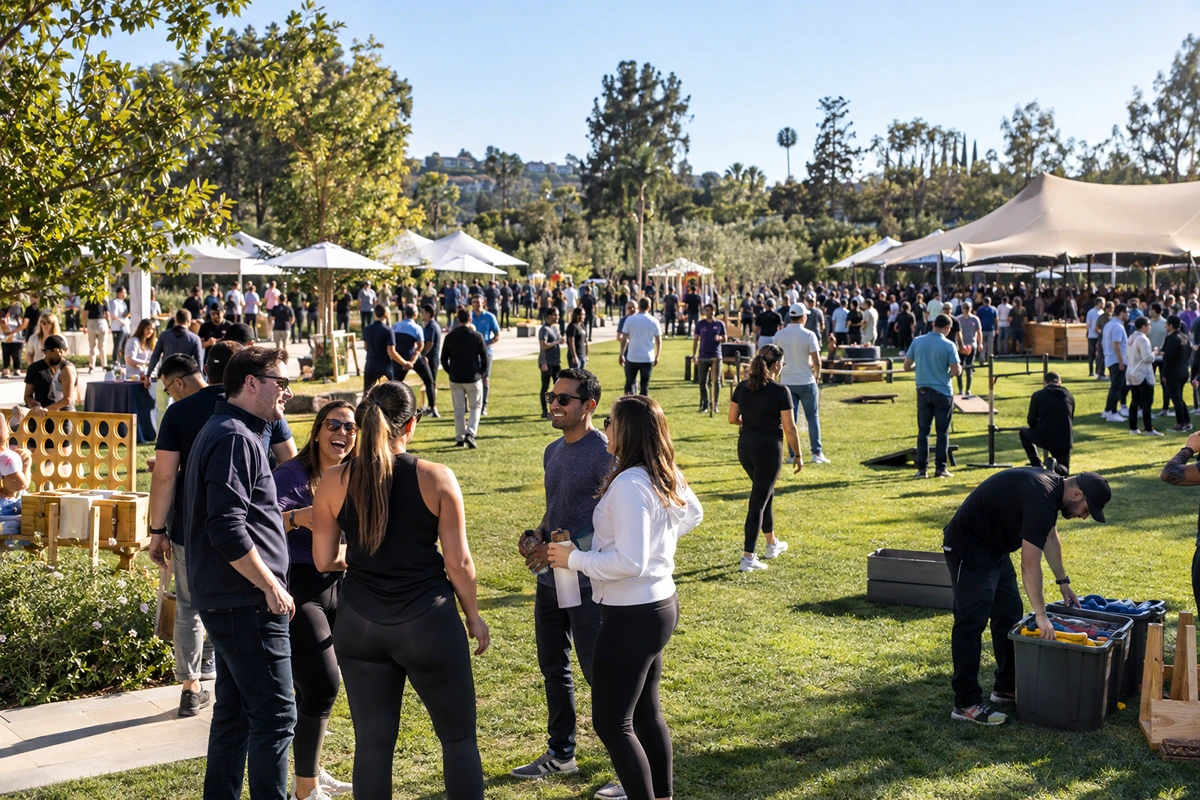
- Field Day And Outdoor Games Circuit
A field day is one of the strongest options for team building events for large teams because the activities can run simultaneously.
Instead of moving the entire group through one game, teams rotate through several stations. This gives the organizer control over traffic and keeps participants active throughout the program.
- Works at: 250–500 people
- Space: Large outdoor field or multiple connected activity areas
- Runs: 2–4 hours
- Staffing: One facilitator per station, plus floor leads
- Watch for: Poor station spacing or unclear rotation timing
- Stage-Led Game Show
A game show puts the main program on a stage while table teams participate from their seats. This allows hundreds of employees to participate without requiring hundreds of separate activity stations, a format built for corporate team building events for large groups, not adapted from a smaller one.
An emcee can control the pace, while floor staff manage microphones, answers, prizes, team communication, and movement.
- Works at: 250–500 people
- Space: Ballroom or auditorium with stage and audience seating
- Runs: 90–120 minutes
- Staffing: One host plus floor staff and an event lead
- Watch for: A format that relies too heavily on volunteers from the audience
- Venue-Wide Scavenger Hunt
A scavenger hunt can spread a large group across a venue, campus, hotel, or approved district. Teams receive challenges and checkpoints rather than gathering at one location.
For corporate groups, the strongest structure uses mixed teams and timed checkpoints. The organizer should also establish clear boundaries, accessibility routes, communication methods, and emergency procedures.
- Works at: 250–500 people
- Space: Large venue, campus, or controlled outdoor area
- Runs: 2–3 hours
- Staffing: One staff member per major checkpoint or zone, plus roaming leads
- Watch for: Teams bunching at the same checkpoint
- Conference-Style Interactive Breakouts
A corporate offsite does not need to become a traditional game to support team building. Facilitated breakout sessions can turn an existing conference setup into a structured team activity, which is why they show up so often on lists of team building events for large teams.
Employees work in smaller table groups on timed challenges, problem-solving exercises, or collaborative projects. The format is particularly useful when the company already has a ballroom and breakout rooms.
- Works at: 250–500 people
- Space: Ballroom plus breakout areas
- Runs: 90–150 minutes
- Staffing: One facilitator per breakout group, plus central event staff
- Watch for: Inconsistent facilitation between groups
500+ People
At 500 or more people, stop thinking about the event as one activity. It is a production with a site plan, floor plan, run of show, staff roster, communications plan, and contingency structure. Some of the large-scale staffing lessons from multi-day activations for brands like Spotify apply just as well to corporate team building events for large groups: tiered teams with specialized roles beat a generalist crew once headcount climbs into the hundreds.
- Company Field Day Or Family Day
A large company field day can combine sports, games, food areas, spectator zones, and open social space.
The key is not finding enough games. It is designing enough parallel activity capacity so that 500 or more people do not converge on the same station.
- Works at: 500+ people
- Space: Large outdoor site with multiple zones
- Runs: 3–5 hours
- Staffing: One facilitator per station, plus zone leads and an event captain
- Watch for: Long walks between zones and overcrowded popular activities
- Festival-Format Activity Zones
A festival structure gives employees multiple choices. One zone may offer a competition, another a creative activity, and another a social or spectator experience.
This format handles participation differences well because employees do not have to follow one fixed activity. The tradeoff is a larger staffing and floor-plan requirement, which is typical of corporate team building events for large groups at this scale.
- Works at: 500+ people
- Space: Large indoor or outdoor site with multiple zones
- Runs: 3–5 hours
- Staffing: One staff team per zone, plus roaming floor leads
- Watch for: Uneven traffic between zones
- Large-Scale Game Show
A stage-led game show can accommodate hundreds or even thousands of people when table teams participate simultaneously.
The audience stays largely in place, reducing the movement problem found in station-based activities. Floor staff can manage team interaction while the host and production team control the central program.
- Works at: 500+ people
- Space: Large ballroom or auditorium
- Runs: 90–150 minutes
- Staffing: Host, production support, floor staff, and event lead
- Watch for: Making the audience passive for too long
- Multi-Site Volunteer Day
For very large companies, volunteering does not need to happen at one location. Employees can be divided across several approved sites, each with its own activity and site lead, a format that solves a real gap in corporate team building events for large groups when headcount outgrows any single venue.
A central team manages communications, schedules, transportation where needed, and reporting. Each site operates independently while following the same event plan.
- Works at: 500+ people
- Space: Multiple sites
- Runs: 3–6 hours
- Staffing: One site lead per location plus a central event lead
- Watch for: Communication gaps between sites
Subscribe To Our NewsLetter
We help you to elevate your events with our highly skilled professionals. You got these three simple steps to book our service
What Large-Group Team Building Actually Takes To Run
The activity is usually booked before anyone counts the people needed to run it.
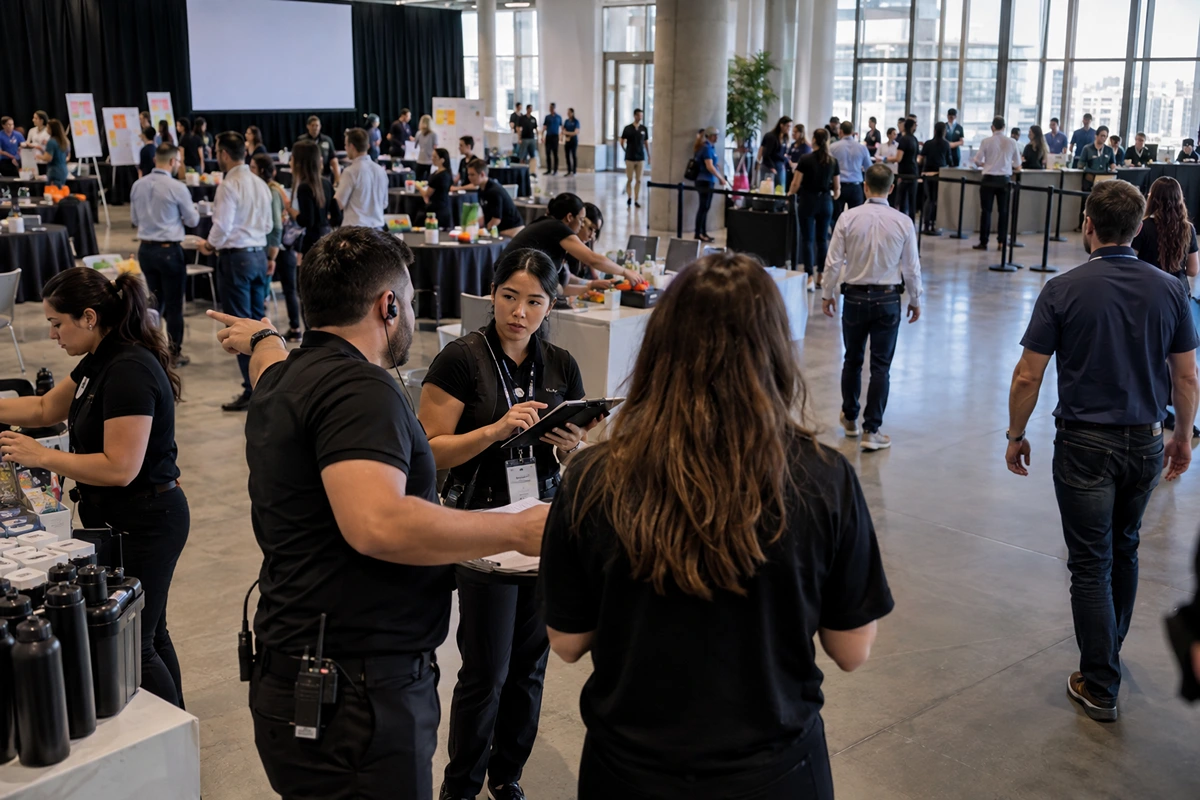
For a station-based event, every station needs coverage for the full program. A 12-station field day for 400 people needs 12 station staff before you add check-in, catering support, floor coverage, or a lead.
A useful PremierStaff planning ratio, laid out in more detail in our event staffing cost calculator, is one event captain or lead for every eight floor staff. Your event staffing ratios should also account for the arrival peak, transitions, registration, and any areas that need continuous coverage. This is where most corporate team building events for large groups actually succeed or fail.
Check-in creates another pressure point. Recent arrival-pattern data across hundreds of live events shows that roughly half of opening-day check-ins land inside a single 60-minute window, so check-in needs to be planned around the arrival peak rather than the total event duration. If you need to determine how many check-in staff you need, size the desk around the arrival pattern and registration process.
Space is another common mistake. A venue’s seated capacity does not automatically mean it can support an active team building program, which is why choosing the right venue matters as much as choosing the activity. Standing activities, stations, queues, equipment, and circulation all require usable floor area.
The same applies to food. Catering for 400 people needs to fit around the activity schedule. If food service occupies the same circulation path as a station rotation, the two programs can compete for space.
Three failures appear repeatedly at scale, and they’re the same ones that show up when an event isn’t prepared for the unexpected:
- The activity cannot absorb the headcount, so half the room queues.
- There are not enough staff between stations, so teams stop moving.
- There is no plan for non-participants, leaving people without a useful place to go.
The activity is only one part of the operating plan. The rest is corporate event staffing.
The activity is usually booked before anyone counts the people needed to run it. Send the headcount, the venue, and the format you’re considering, and the staffing side comes back as a plan: stations, check-in, floor leads, and the transitions between them.
For a broader event plan, review staffing a corporate retreat and the checklist for planning your first corporate event before finalizing the schedule.
What To Look For, What To Avoid, And What Matters Most
Look for:
- Formats that divide people into teams of 8–12
- Formats that support simultaneous participation, or have a clear wave structure
- A staffing number included in the quote
Avoid:
- Activities designed for a room of 20 and simply scaled up on hope
- Single-station activities for hundreds of people
- Booking a venue based only on seated capacity for an active format
- Assuming the activity vendor’s facilitators cover check-in, transitions, floor management, or the rest of the event
What matters most: at this size, the activity is the easy part. Whether 400 people have somewhere to be for every minute of the afternoon is the actual job. That is a staffing and floor-plan question, not an ideas question.
FAQs
What are some good group games for 100 people?
For 100 people, consider themed trivia, station-based field games, cooking competitions, casino-style activities, or charity builds. The best team building activities for 100 employees divide participants into teams of about 8 to 12 and allow multiple groups to participate at the same time. Most of these run on the same corporate event staffing structure, with a coordinator overseeing stations and vendors.
What team building activities work for 200 or more employees?
Field days, game shows, scavenger hunts, charity builds, and interactive breakout sessions can work well for 200 or more employees. Choose formats that can run simultaneously or use a clearly planned rotation system, and lean on trained crowd management staff to keep pathways and checkpoints from bottlenecking.
How do you run team building for a large group?
Divide employees into smaller teams, choose an activity that can operate in parallel, and plan the venue around movement between groups. You should also account for check-in staff, floor staff, facilitators, transitions, and employees who choose not to participate. This is the core planning logic behind every one of the corporate team building events for large groups covered above.
How many staff do you need for a large team building event?
Staffing depends on the format and number of activity stations. Station-based events typically need one facilitator per station, along with check-in and floor staff. A useful PremierStaff planning ratio is one event lead or captain for every eight floor staff. A full breakdown of roles is available through our hospitality staffing services.
How much space does a large group team building event need?
Large team building events for large teams need more usable space than a seated event with the same headcount. Account for activity stations, participant circulation, queues, equipment, staff positions, and areas for employees who are not participating, including the footprint your catering staff will need to keep food service out of the way of the activity flow.
Choose The Format That Fits The Numbers
Most “large group” team building lists are not actually built for large corporate groups. They often start at 20 people and stop before the logistics become difficult.
Above 100, the question changes from “What should we do?” to “What will it take to run this well?”
For corporate team building events for large groups, test every format against three requirements: can people work in sub-groups, can the activity run simultaneously or through planned waves, and is there a practical plan for employees who do not participate?
Get those three decisions right, then build the staffing plan around them.
PremierStaff staffs corporate team building events for large groups across Los Angeles and twenty-one other cities, including check-in teams, floor staff, hospitality staff, and event captains. Send us your date, headcount, and venue, and we will tell you what the day needs.
Are You Ready to Elevate Your Event?
Don’t wait—book Premier Staff now to secure top-tier professionals for your next event.
Recommended Posts

An event brand ambassador is the person who represents your brand to guests from setup to wrap-up. Before your event,...